
Titanium Grade 3, Sheet & Coil, AMS 4900 (CP Grade 3) - UNS R50550
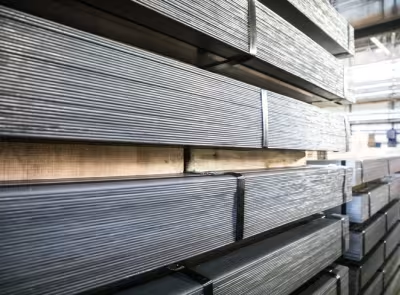
CP Grade 3 Titanium is a general‑purpose commercially pure (CP), unalloyed titanium grade that offers an excellent combination of corrosion resistance, strength, and weight efficiency. It provides superior resistance to corrosion in highly oxidizing to mildly reducing environments, including exposure to chlorides, making it well suited for demanding industrial and marine service. CP Grade 3 features an excellent strength‑to‑weight ratio and carries the highest ASME allowable design stresses of any commercially pure titanium grade, positioning it between CP Grade 2 and alloyed titanium grades in terms of performance. United Performance Metals stocks CP Grade 3 in coil and sheet sizes from 0.012” to 0.063”, supporting applications across space, chemical processing, marine, and select medical environments where enhanced strength and corrosion resistance are required.
- Inventory & Specs
- Chemical Composition
- Physical Properties
- Mechanical Properties
- Datasheet
- Additional Info
- FAQs
Inventory Size Ranges for CP Grade 3
| Type | Size Range | AMS Standards | ASTM | UNS | Get a Quote |
|---|---|---|---|---|---|
| Coil | 0.012" - 0.063" | AMS 4900 | ASTM F 67, ASTM B265 | UNS R50550 | Get a Quote |
| Sheet | 0.012" - 0.063" | AMS 4900 | ASTM F 67, ASTM B265 | UNS R50550 | Get a Quote |
Characteristics of CP Grade 3
CP Grade 3 Titanium is distinguished by its highest ASME allowable design stresses among commercially pure titanium grades, making it suitable for applications requiring higher load‑bearing capability without sacrificing corrosion resistance. The alloy maintains good performance in aggressive environments, including chloride‑containing and oxidizing conditions, while delivering enhanced strength compared to CP Grade 2. It also exhibits good impact properties at low temperatures, allowing it to retain toughness and reliability in cold or cryogenic service conditions. In addition, CP Grade 3 is biocompatible, enabling its use in certain medical and biomedical applications where purity and corrosion resistance are essential.
Working with CP Grade 3
CP Grade 3 Titanium offers excellent process flexibility and can be welded, machined, cold worked, hot worked, and cast using established titanium fabrication practices. While it has higher strength than lower CP grades, it remains relatively easy to form and join when proper procedures are followed. Welding is commonly performed using standard inert gas shielding techniques to prevent contamination, and machining requires appropriate tooling and controlled cutting parameters. Its combination of manufacturability and performance makes CP Grade 3 a practical choice for complex fabrications and critical components in demanding service environments.
Other industry standards we comply with:
- DFARS Compliant
Common Trade Names
- Grade 3 Titanium
- Gr. 3 Titanium
- CP 3 Titanium
Industry Applications for CP Grade 3
- Aerospace Structures
- Chemical Processing
- Medical Industry
- Marine Industry
Chemical Composition
| Element | Min | Max | |
|---|---|---|---|
| N | Nitrogen | - | 0.05 |
| C | Carbon | - | 0.08 |
| O | Oxygen | - | 0.35 |
| Fe | Iron | - | 0.30 |
| H | Hydrogen | - | 0.015 |
| Ti | Titanium | - | Remainder |
| - | Res. Each | - | 0.1 |
| - | Res. Total | - | 0.4 |
Physical Properties
| Physical Property | T (°F) | T (°C) | Value | Value (SI) |
|---|---|---|---|---|
| Density | - | - | 0.1630 lb/in³ | 4.512 g/cm3 |
| Beta Transus | 1690 | - | - | - |
Thermal Conductivity | - | - | 151.2 Btu-in/hr ft²- °F | - |
Electrical Resistivity | - | - | 21 μΩ∙in | .53 μΩ∙m |
| Magnetic Permeability | - | - | Nonmagnetic | |
Mean Coefficient of | 68-212 | 20-100 | 4.8x10¯⁶in in¯¹°F¯¹ | 8.6x10¯⁶m m¯¹°C¯¹ |
| Thermal Expansion | 68-572 | 20-300 | 5.3x10¯⁶in in¯¹°F¯¹ | 9.5x10¯⁶m m¯¹°C¯¹ |
68-932 | 20-500 | 5.4x10¯⁶in in¯¹°F¯¹ | 9.7x10¯⁶m m¯¹°C¯¹ | |
| Elastic Modulus | - | - |
| - |
Mechanical Properties
| UTS, ksi (MPa) | .02% YS, ksi (MPa) | %EI | %RA |
|---|---|---|---|
| 85 (595) | 65 (450) | 25 | 48 |
Datasheet
Additional Info
A Brief History of CP Grade 3
Commercially Pure (CP) Grade 3 Titanium is part of the original family of unalloyed titanium grades that emerged as titanium became commercially viable in the mid‑20th century. As industries began seeking materials that could outperform stainless steels in corrosive and weight‑sensitive environments, CP titanium grades quickly gained attention for their exceptional corrosion resistance and favorable strength‑to‑weight ratios. CP Grade 3 was developed to provide higher strength than CP Grades 1 and 2, while retaining the corrosion resistance and fabrication characteristics that made commercially pure titanium attractive for industrial, aerospace, and marine applications.
Often selected as a step‑up in performance from CP Grade 2, CP Grade 3 helped expand the use of titanium into applications requiring higher allowable stress levels without moving to more complex alloyed titanium grades.
How CP Grade 3 Was Developed
CP Grade 3 Titanium was developed through advances in refining, melting, and compositional control that allowed titanium producers to finely regulate interstitial elements such as oxygen and iron. Unlike alloyed titanium grades that rely on aluminum or vanadium additions for strength, CP Grade 3 achieves its enhanced mechanical properties through controlled purity and microstructure. This results in higher strength and the highest ASME allowable design stresses of any commercially pure titanium grade, while maintaining excellent ductility and corrosion resistance.
By balancing strength and formability, CP Grade 3 became well suited for applications that demand improved load‑carrying capability without sacrificing weldability or corrosion performance. These characteristics positioned it as an attractive alternative to both lower‑strength CP grades and heavier corrosion‑resistant alloys.
Early Applications of CP Grade 3
Early use of CP Grade 3 Titanium was driven by industries operating in aggressive chemical and marine environments, where corrosion resistance was critical and weight reduction offered operational benefits. The alloy found early adoption in chemical processing equipment such as tanks, pressure vessels, piping, and heat exchangers, particularly where higher design stresses required improved strength over CP Grade 2.
CP Grade 3 was also used in early aerospace and space applications, where its strength‑to‑weight ratio and resistance to environmental degradation supported non‑structural and semi‑structural components. Its resistance to seawater corrosion further enabled use in marine and offshore systems.
How CP Grade 3 Is Used Today
Today, CP Grade 3 Titanium continues to be selected for industrial, aerospace, chemical, and marine applications where enhanced strength and corrosion resistance are required. It is commonly used in chemical processing equipment, heat exchangers, pressure vessels, marine hardware, and aerospace components exposed to corrosive service environments. CP Grade 3 also provides good impact properties at low temperatures, supporting use in cold‑service and cryogenic‑adjacent applications.
Its biocompatibility allows CP Grade 3 to be used in select medical and biomedical applications, while its manufacturability—through welding, forming, machining, and casting—supports complex fabrications. These attributes make CP Grade 3 a versatile titanium grade for applications that demand higher performance than CP Grade 2 without transitioning to alloyed titanium.
Your Trusted Supplier for CP Grade 3
United Performance Metals is a global specialty metals solutions provider offering CP Grade 3 Titanium in coil and sheet thicknesses ranging from 0.012″ to 0.063″. With deep expertise in titanium materials, precision processing capabilities, and strong quality and certification support, UPM delivers materials tailored to demanding industrial, aerospace, marine, and medical applications.
Contact our team today to learn how CP Grade 3 Titanium can support your next corrosion‑resistant, high‑performance application.
Product FAQs
CP Grade 3 Titanium is used in applications requiring enhanced strength compared to CP Grade 2, while maintaining excellent corrosion resistance and lightweight performance. Common applications include chemical processing equipment, marine components, heat exchangers, pressure vessels, aerospace and space structures, and select medical applications where higher allowable stress levels are needed.