
304 Stainless Steel Sheet, Coil, and Plate - AMS 5511, 5513
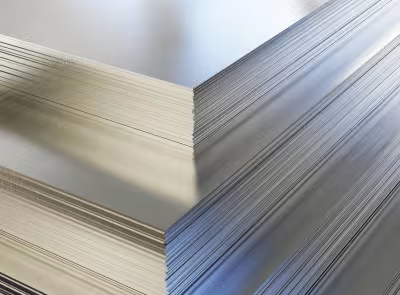
304 stainless steel is the most widely used austenitic stainless steel, offering an excellent combination of corrosion resistance, weldability, formability, and strength. Compared to Type 302, 304 contains a higher chromium content and lower carbon content, allowing it to be used in many applications in the as-welded condition without post-weld annealing.
304 stainless steel is commonly used in food processing equipment, tanks, piping, heat exchangers, fasteners, architectural components, and wide range of industrial and consumer applications. Its excellend fabrication characteristics allow it to be readily formed, welded, machined, and polished, making it a versatile choice for applications requiring both durability and corrosion resistance.
- Inventory & Specs
- Chemical Composition
- Physical Properties
- Mechanical Properties
- Datasheet
- Additional Info
- FAQs
Inventory Size Ranges for 304
| Type | Size Range | AMS Standards | ASTM | UNS | ASME | Get a Quote |
|---|---|---|---|---|---|---|
| Coil | 0.016" - 0.125" | AMS 5513 | ASTM A 240, ASTM A 666 | UNS S30400 | ASME SA 240 | Get a Quote |
| Sheet | 0.016" - 0.125" | AMS 5513 | ASTM A 240, ASTM A 666 | UNS S30400 | ASME SA 240 | Get a Quote |
| Plate | 0.1875" - 2.000" | AMS 5513 | ASTM A 240 | UNS S30400 | ASME SA 240 | Get a Quote |
| Precision Reroll Strip | 0.0008" - 0.015" | AMS 5513 | ASTM A 666 | Get a Quote |
Advanced Inventory Size Ranges for 304
| Type | Size Range | Specifications | Get a Quote |
|---|---|---|---|
| Build Plates | 0.500" - 5.000" | AMS 5511, AMS 5513, ASTM A 240, ASTM A 666, UNS S30400, ASME SA 240 | Get a Quote |
| Feedstock | 1.37" - 5.90" | ASTM A276 | Get a Quote |
Characteristics of 304
304 stainless steel is the most widely used stainless steel alloy because it provides an excellent balance of corrosion resistance, formability, weldability, and strength. As an austenitic 18-8 stainless steel containing approximately 18% chromium and 8% nickel, 304 performs well in atmospheric environments, fresh water, food processing applications, and exposure to many mild chemicals. Its attractive appearance, ease of fabrication, and reliable corrosion resistance make it a preferred choice for tanks, piping systems, food processing equipment, architectural components, and a wide range of general industrial applications.
Working with 304
304 stainless steel is readily formed, welded, machined, and fabricated using conventional manufacturing methods. The alloy offers excellent ductility and can be deep drawn, bent, rolled, and stamped into complex shapes while maintaining good mechanical properties. 304 is commonly supplied with a bright finish and responds well to polishing, brushing, and passivation. Following fabrication, passivation may be used to remove surface contaminants and promote the formation of the protective chromium-rich oxide layer that provides the alloy's corrosion resistance. Its combination of workability, weldability, and durability makes 304 one of the most versatile stainless steels available for both commercial and industrial applications.
Other industry standards we comply with:
- W.NR 1.4307
- PWA-LCS
- GE Aircraft Engine (GT193)
- GE Aviation S-SPEC-35 AeDMS S-400
- RR SABRe Edition 2
- DFARS Compliant
Common Trade Names
- ATI 304 (™ Allegheny Technologies)
Industry Applications for 304
- Aerospace structures
- Base plates and fasteners
- Food and beverage industry
- Pressure containing applications
- Architectural structures and design features, moldings and trims
- Sanitary or cryogenic applications
- Chemical industry processing equipment
- Containers for chemicals or transport
- Burst discs
Chemical Composition
| Element | Min | Max | |
|---|---|---|---|
| C | Carbon | 0.08 | - |
| Mn | Manganese | - | 2.00 |
| P | Phosphorus | - | 0.045 |
| S | Sulfur | - | 0.03 |
| Si | Silicon | - | 0.75 |
| Cr | Chromium | 18.000 | 20.000 |
| Ni | Nickel | 8.000 | 12.00 |
| N | Nitrogen | - | 0.10 |
| Fe | Iron | - | Balance |
Physical Properties
| Property | Value |
|---|---|
| Density | 0.29 lb/in3 (8.03 g/cm3) |
| Modulus of Elasticity in Tension | 29 x 106 psi (200GPa) |
| Magnetic Permeability | H/m Annealed 1.02 Max @ 200 H |
| Temperature Range | Mean Coefficient of Thermal Expansion | ||
|---|---|---|---|
| °C | °F | mm/mm/°C | in/in/°F · 10? |
| 20 - 100 | 68 - 212 | 16.6 · 10-6 | 9.2 · 10-6 |
| 20 - 870 | 68 - 1600 | 19.8 · 10-6 | 11 · 10-6 |
| Temperature Range | W/m · K | Btu/(hr/ft²/in/°F) | |
|---|---|---|---|
| °C | °F | ||
| 100 | 212 | 16.3 | 9.4 |
| 500 | 932 | 21.4 | 12.4 |
| °C | °F | J/kg °K | Btu/lb/°F) |
|---|---|---|---|
| 0-100 | 32-212 | 500 | 0.12 |
| °C | °F | Microhm-cm | Microhm-in. |
|---|---|---|---|
| 20 | 68 | 72 | 28.3 |
| 100 | 212 | 78 | 30.7 |
| 200 | 392 | 86 | 33.8 |
| 400 | 752 | 100 | 39.4 |
| 600 | 1112 | 111 | 43.7 |
| 800 | 1472 | 121 | 47.6 |
| 900 | 1652 | 126 | 49.6 |
Mechanical Properties
| Property | 302, 304 | 304L |
|---|---|---|
| 0.2% Offset Yield Strength, psi (MPa) | 42 (290) | 35 (241) |
| Ultimate Tensile Strength, psi (MPa) | 90 (621) | 85 (586) |
| Elongation % in 2 in. (50.8 mm) | 55 | 55 |
| Hardness Rockwell | B82 | B80 |
Datasheet
Additional Info
A Brief History of 304
304 stainless steel belongs to the austenitic 18/8 family, named after is 18% chromium and 8% nickel composition. The foundation of stainless steel began in 1913, when Harry Brearley discovered that high‑chromium steels resisted rust. Over the next decade, researchers in Europe and the U.S. refined chromium‑nickel alloys into stable austenitic steels. In 1924, W. H. Hatfield at Firth Brown Steel formalized the modern 18/8 composition and marketed it as “Staybrite 18/8”, which became today’s 304 stainless steel.
How 304 Was Developed
Early stainless steels were martensitic and difficult to form; adding nickel stabilized the austenitic structure, improving ductility and corrosion resistance. Metallurgists experimented with chromium-nickel ratios until the 18/8 balance proved optimal for corrosion resistance, formability, weldability, and non-magnetic behavior. Hatfield's 1924 formulation became the global standard and is now designated UNS S30400.
Early Applications of 304
Because of its corrosion resistance and ease of fabrication, early uses included cutlery and kitchenware, architectural trim and panels, chemical processing equipment, food handling and dairy equipment, household items, and industrial tanks and pipes. These applications leveraged the alloy's ability to resist rust while being easily rolled, stamped, and welded.
How 304 is Used Today
304 remains the most widely used stainless steel in the world due to its versatility, cost-effectiveness, and corrosion resistance. Some of the most popular applications include:
- Food and Beverage: Tanks, piping, brewing equipment, commercial kitchen surfaces
- Architecture & Construction: Handrails, cladding, roofing, structural components
- Consumer Products: Appliances, cookware, sinks, water bottles
- Automotive & Transportation: Exhaust components, trim, brackets
- Industrial & Chemical Processing: Heat exchangers, storage vessels, pumps
- Medical: Sterile tables, instruments, clean-room hardware
- Fasters: Bolts, nuts, screws
Your Trusted Supplier for 304 Stainless
United Performance Metals carries 304 coil and sheet 0.016" - 0.125". plate 0.1875" - 2.000", and precision rerolled strip 0.0008" - 0.015". 304 is widely used in equipment and utensils for processing and handling of food, beverages and dairy products. Heat exchangers, piping, tanks and other process equipment in contact with fresh water also utilize this alloy. Other applications include building facades, architectural and structural applications exposed to non-marine atmospheres, and household and industrial chemicals.
Product FAQs
304 is one of the most widely used stainless grades due to its excellent corrosion resistance, good strength, and its ease of fabrication and welding.
304 is more economical and is widely used due to its corrosion resistance. However, 304 is susceptible to chloride pitting, which makes 316 the superior choice for marine environments and other corrosive applications.