
410 Stainless Steel - AMS 5504 - UNS S4100
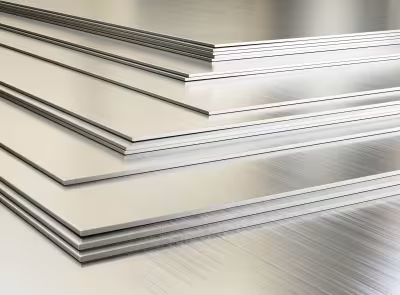
Grade 410 stainless steel is a hardenable, martensitic stainless steel that features a minimum addition of 11.5% chromium. This addition of chromium provides a significant increase in corrosion resistance in mildly corrosive environments where high strength and moderate heat resistance are required. Along with corrosion resistance, this material demonstrates high strength and hardness and is magnetic in both the annealed and hardened conditions. Alloy 410 (AMS 5504) can adequately resist sulfuric acid, nitric acid, and weak acetic acid.
- Inventory & Specs
- Chemical Composition
- Physical Properties
- Mechanical Properties
- Datasheet
- Additional Info
- FAQs
Inventory Size Ranges for 410
| Type | Size Range | AMS Standards | ASTM | UNS | ASME | Get a Quote |
|---|---|---|---|---|---|---|
| Coil | 0.020" - 0.140" | AMS 5504, AMS 5613 (Chem only) | ASTM A 240, ASTM A 276, ASTM A 493, ASTM F 899 | UNS S41000 | ASME SA 240 | Get a Quote |
| Sheet | 0.020" - 0.140" | AMS 5504, AMS 5613 (Chem only) | ASTM A 240, ASTM A 276, ASTM A 493, ASTM F 899 | UNS S41000 | ASME SA 240 | Get a Quote |
| Plate | 0.1875" - 1.000" | AMS 5504, AMS 5613 (Chem only) | ASTM A 240, ASTM A 276, ASTM A 493, ASTM F 899 | UNS S41000 | ASME SA 240 | Get a Quote |
| Bar | 1.000" - 8.000" | AMS 5504, AMS 5613 (Chem only) | ASTM A 240, ASTM A 276, ASTM A 493, ASTM F 899 | UNS S41000 | ASME SA 240 | Get a Quote |
Characteristics of 410
Type 410 stainless steel displays high strength, heat resistance, and good ductility, making it ideal for the manufacturing of products like bolts, nuts, springs and fasteners, as it can be machined after tempering or annealing. This grade is also commonly used in the manufacturing of durable cutlery and kitchen utensils, where its properties allow it to resist the acidity of food products and general corrosion. Alloy 410 exhibits good corrosion resistance to atmospheric corrosion, potable water, and to mildly corrosive chemical environments because of its ability to form a tightly adherent oxide film which protects its surfaces from further attack. Its exposure to chlorides in everyday type activities (e.g., food preparation, sport activities...) is generally satisfactory when proper cleaning is performed after exposure to use. For maximum corrosion resistance to chemical environments, it is essential that the stainless steel surface be free of all heat tint or oxide formed during forging, annealing, or heat treating.
Working with 410
To anneal this alloy, heat to 1550°F-1650°F (843-899°C). Such annealing should produce a Brinell hardness of 126-192 HB in ATI 410 material. A hardening heat treatment is necessary to bring out the maximum hardness and wear resistance. Since this material absorb heat very slowly, it should be heated gradually and allowed to remain at temperature long enough to ensure uniform temperature in thick sections. For maximum strength, hardness, and corrosion resistance, slowly heat the alloy to 1800°F (982°C). This alloy should be machined in the annealed condition using surface speeds of 60 to 80 feet (18.3-24.4 m) per minute. The initial forging temperature range is 2000-2200°F (1093-1204°C). Forging or hot working should always be followed by annealing to avoid stress cracking.
Other industry standards we comply with:
- EN 1.4006
- PWA-LCS
- GE Aircraft Engine (GT193)
- GE Aviation S-SPEC-35 AeDMS S-400
- RR SABRe Edition 2
- DFARS Compliant
Common Trade Names
- ATI 410 (™ Allegheny Technologies)
- Alloy 410
- AISI Type 410
- 410 SS
Industry Applications for 410
- Aerospace structures
- Automotive exhausts, manifolds and high temperature engine components
- Medical instruments and devices
- Knives and kitchen utensils
- Petro-chemical applications
- Stainless steel cutlery, kitchen utensils
- Manufacturing flat springs
- Hand tools
- Bolts, nuts, springs and fasteners
Chemical Composition
| Element | Min | Max | |
|---|---|---|---|
| C | Carbon | - | 0.15 |
| Mn | Manganese | - | 1.00 |
| Si | Silicon | - | 1.00 |
| Cr | Chromium | 11.50 | 13.50 |
| Ni | Nickel | - | 0.75 |
| S | Sulfur | - | 0.03 |
| P | Phosphorus | - | 0.04 |
Physical Properties
| Property | Value |
|---|---|
| Density | 0.276 lb/in3 |
| Specific Gravity | 7.65 |
| Melting Range | 2700-2790°F (1482-1532°C) |
| Modulus of Elasticity | 29 x 106 psi (200 GPa) |
| Specific Heat | 0.11 Btu/lb. ·°F |
| Temperature Range | Coefficients | ||
|---|---|---|---|
| °C | °F | cm/cm/°C | in/in/°F |
| 20-200 | 68-392 | 10.5 x10⁻⁶ | 5.9 x 10⁻⁶ |
| 20-600 | 68-1112 | 11.6 x 10⁻⁶ | 6.5 x 10⁻⁶ |
| Temperature Range | W/m·K | Btu/(hr · ft · °F) | |
|---|---|---|---|
| °C | °F | ||
| 100 | 212 | (0.249) | 14.4 |
| Temperature Range | microhm-cm | |
|---|---|---|
| °C | °F | |
| 20 | 68 | 56 |
Mechanical Properties
| Typical Annealed Properties | Hardening Response HRC | |||
|---|---|---|---|---|
| HRB | 0.2% Offset Yield Strength, Ksi (MPa) | Tensile Strength, Ksi (MPa) | Elongation % in 2" (51mm) | |
| 82-96 | 30 (205) - 42 (290) | 65 (450) - 74 (510) | 20 -34 | 38-45 |
Datasheet
Additional Info
A Brief History of 410
410 stainless steel was developed in the early 20th century as industries sought a material that offered both high strength and corrosion resistance. It belongs to the martensitic stainless steel family, which emerged as engineers experimented with chromium additions to carbon steels to improve rust resistance while retaining hardenability. With about 12% chromium, 410 became one of the first commercially successful martensitic stainless steels, offering a balance of hardness, durability, and moderate corrosion resistance.
How 410 Was Developed
Early stainless steels were either corrosion resistant but soft (austenitic) or hard but prone to rust. Metallurgists increased chromium content to ~12% and controlled carbon levels to create a steel that could be heat‑treated to martensite, giving it high hardness and strength. This development produced an alloy that could be quenched and tempered like carbon steel, offered better corrosion resistance than tool steels, and maintained good mechanical strength at elevated temperatures. The result was AISI 410 (UNS S41000), the foundational martensitic stainless grade.
Early Applications of 410
Early industrial uses focused on applications requiring wear resistance, hardness, and moderate corrosion protection. Application included cutlery, fasteners, steam turbine components, pumps, valves, and automotive and industrial tools. These applications took advantage of 410's ability to be hardened while still resisting rust better than carbon steels.
How 410 is Used Today
410 remains one of the most widely used martensitic stainless grades because it is strong, hardenable, wear resistant, and cost effective. Modern applications include:
- Aerospace: Jet engine components, turbine blades
- Power General: Gas turbine parts, steam turbine blades
- Industrial: Pump shafts, valve components, compressor parts
- Cutlery: Knives, scissors, hand tools
- Automotive: Exhaust components, brackets
- Oil & Gas: Downhole tools, refinery components
- Medical: Surgical instruments, processing blades
Your Trusted Supplier for 410 Stainless
United Performance Metals stocks 410 coil and sheet in 0.020" - 0.140", 410 plate in 0.1875" - 1.000", and 410 bar in 1.000" - 8.000". This product is commonly used in the aerospace, automotive, medical, fastener, and chemical industries.
Product FAQs
410 stainless steel is typically chosen due to its good wear resistance, magnetic properties, and the fact that it is heat-treatable to high hardness.
410 stainless steel has a lower corrosion resistance than other grades such as 304 and 316. 410 is not suitable for marine or chloride-rich environments, has reduced toughness at low temperatures, and requires heat treatment to achieve full potential.
When quenched and tempered, 410 can reach Rockwell C 40–45, depending on carbon content and heat‑treat cycle.