
301 Stainless Steel Sheet & Coil - AMS 5901
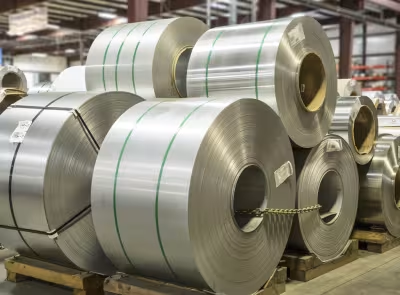
Type 301 is an austenitic stainless steel with a nominal composition of 17 percent chromium and 7 percent nickel, which provides good strength and ductility when cold worked. It also has excellent corrosion resistance properties. 301 is well suited to welding, forming, and drawing. This high strength grade of steel is available in several conditions or tempers. United Performance Metals also supplies 301 in its Full Hard, 1/2 Hard and 1/4 Hard conditions.
- Inventory & Specs
- Chemical Composition
- Physical Properties
- Mechanical Properties
- Datasheet
- Additional Info
- FAQs
Inventory Size Ranges for 301
| Type | Size Range | AMS Standards | ASTM | UNS | ASME | Get a Quote |
|---|---|---|---|---|---|---|
| Coil | 0.020" - 0.125" | AMS 5901 | ASTM A 240, ASTM A 666 | UNS S30100 | ASME SA 240, ASME SA 666 | Get a Quote |
| Sheet | 0.020" - 0.125" | AMS 5901 | ASTM A 240, ASTM A 666 | UNS S30100 | ASME SA 240, ASME SA 666 | Get a Quote |
| Precision Reroll Strip | 0.0008" - 0.015" | Get a Quote |
Characteristics of 301
301 is corrosion resistant to a variety of environmental conditions but is not as good as the 18-8 chromium nickel steels. This alloy possesses good resistance to oxidation at temperatures up to 1550°F (840°C). At 1600°F (871°C), alloy 301 exhibits an oxidation weight gain of 10mg/cm2 in 1,000 hours. Due to this factor, 301 is not suggested for use at 1600°F or above. As the rate of oxidation is greatly affected by the atmosphere to which the metal is exposed by the heating and cooling cycle, and by the structural design, no data can be presented which will apply to all service conditions.
Working with 301
Alloy 301 is used in the annealed and cold-rolled conditions. In the work-hardened condition, this alloy develops higher tensile strength than the other stable austenitic grades. Annealed austenitic stainless steels exhibit high resistance to impact even at low temperatures. This property, in combination with strength and fabricability, has led to their use in cryogenic applications.
The endurance limit of annealed 301 is 30-45% of the tensile strength. Cold rolling increases the endurance limit as compared with annealed material. Stress relieving increases the endurance limit of cold rolled material. The primary purposes of annealing are to remove the stresses, recrystallize the structure if the material has been previously cold worked, and to take the carbides into solution. Rapid cooling through the carbide precipitation range is necessary to keep the carbides into solution. For thin sections, air cooling is sufficient for this purpose while heavier sections have to be water quenched. When properly annealed, 301 stainless is austenitic. It is possible that small quantities of delta ferrite are present. Cold rolling promotes the formation of martensite and exposure in the 800-1500°F (427-816°C) range results in grain boundary carbide precipitation.
Other industry standards we comply with:
- EN 1.4310
- PWA-LCS
- GE Aircraft Engine (GT193)
- GE Aviation S-SPEC-35 AeDMS S-400
- RR SABRe Edition 2
- DFARS Compliant
Common Trade Names
- ATI 301 (™ Allegheny Technologies)
Industry Applications for 301
- Aircraft structural parts
- Trailer bodies
- Architectural (roof drainage/door frames, etc.)
- Auto body trim and wheel covers
- Utensils and tablewear
- Conveyor parts
Chemical Composition
| Element | Min | Max | |
|---|---|---|---|
| C | Carbon | - | 0.150 |
| Mn | Manganese | - | 2.000 |
| P | Phosphorus | - | 0.045 |
| S | Sulfur | - | 0.030 |
| Si | Silicon | - | 1.00 |
| Cr | Chromium | 16.00 | 18.00 |
| Ni | Nickel | 6.000 | 8.000 |
| N | Nitrogen | - | 0.10 |
Physical Properties
| Property | Value |
|---|---|
| Density | 0.2850 lb/in3 (7.88g/cm3) |
| Melting Range | 2250 - 2950°F (1399 - 1421°C) |
| Specific Gravity | 8.03 |
| Modulus of Elasticity in Tension | 28x106 psi (193 GPa) |
| Magnetic Permeability | 1.02 Max @ 200 H |
| Temperature Range | Coefficients | ||
|---|---|---|---|
| °C | °F | cm/cm°C | in/in/°F |
| 20-100 | 68-212 | 16.6·10-6 | 9.2·10-6 |
| 20-300 | 68-572 | 17.6·10-6 | 9.8·10-6 |
| 20-500 | 68-932 | 18.6·10-6 | 10.3·10-6 |
| 20-700 | 68-1292 | 19.5·10-6 | 10.8·10-6 |
| 20-871 | 68-1600 | 19.8·10-6 | 11.0·10-6 |
| Temperature Range | Coefficients | ||
|---|---|---|---|
| °C | °F | W/m·K | Btu/(hr/ft²/hr/°F/ft) |
| 20-100 | 68-212 | 16.30 | 9.40 |
| 20-500 | 68-932 | 21.40 | 12.4 |
| Temperature Range | J/kg°K | Btu/lb/°F | |
|---|---|---|---|
| °C | °F | ||
| 0-100 | 32-212 | 500 | 0.12 |
| Temperature Range | microhm-cm | microhm-in | |
|---|---|---|---|
| °C | °F | ||
| 20 | 68 | 72 | 28.3 |
| 100 | 212 | 78 | 30.7 |
| 200 | 392 | 86 | 33.8 |
| 400 | 752 | 100 | 39.4 |
| 600 | 1112 | 111 | 43.7 |
| 800 | 1472 | 121 | 47.6 |
| 900 | 1652 | 126 | 49.6 |
Mechanical Properties
Type 301 is used in the annealed and cold rolled conditions. In the work-hardened condition, Type 301 develops higher tensile strength than the other stable austenitic grades. Minimum properties for plate, sheet and strip per ASTM A240 and A666 follow.
| Condition | Tensile Strength, Min. | 0.2% Yield Strength, Min. | Elong. In 2" (50mm) | ||
|---|---|---|---|---|---|
| Ksi | MPa | Ksi | MPa | %, Min. | |
| Annealed | 75 | 515 | 30 | 205 | 40 |
| 1/4 Hard | 125 | 862 | 75 | 517 | 25 |
| 1/2 Hard | 150 | 1034 | 110 | 758 | 18* |
| 3/4 Hard | 175 | 1207 | 135 | 931 | 12* |
| Full Hard | 185 | 1276 | 140 | 965 | 9* |
* Value shown for thickness greater than 0.015 in. (.038mm).
Datasheet
Additional Info
A Brief History of 301
301 stainless steel is an austenitic chromium‑nickel stainless steel introduced in the mid‑20th century as part of the expansion of the 300‑series stainless steels. It was designed to offer higher strength through cold working while maintaining good corrosion resistance. As industries like aerospace, automotive, and consumer manufacturing grew after World War II, 301 became a go‑to alloy for high‑strength, formable stainless components.
How 301 Was Developed
301 was engineered as a variation of 304 stainless steel, with a slightly lower nickel content. This adjustment was intentional and strategic. One of the main goals was to create an alloy that work-hardened rapidly to achieve high strength without heat treatment. Additionally, metallurgists were looking to create an alloy that could maintain corrosion resistance, improve formability, and could be used in springs and structural components without relying on precipitation hardening.
Early Applications of 301
As soon as it was introduced, 301 found rapid adoption in industries that needed strong, corrosion‑resistant, formable metal. Early uses in the 1950s-1970s included railcar and truck components, aircraft structural parts, springs, architectural trim and panels, and household appliances. Its ability to be formed into complex shapes and then strengthened through cold work made it ideal for mass‑manufactured stainless components.
How 301 is Used Today
301 remains a highly versatile alloy and is still widely used across modern industries including:
- Aerospace: Structural components, clamps, brackets, fasteners, springs, and diaphragms
- Automotive & Transportation: Trim and molding, structural reinforcements, and exhaust components
- Industrial & Manufacturing: Conveyor belts, springs, roll-formed shapes, and precision stamping
- Architecture & Construction: Decorative panels, elevator doors, trim, and building facades
- Consumer Products: Appliance components, kitchen equipment, tools, and hardware.
Your Trusted Supplier for 301 Stainless
UPM carries this product in coil and sheet 0.020" - 0.125" and precision rerolled strip 0.0008" - 0.015". This material is commonly used for automotive trim and wheel covers, fastener clamps and springs, as well as truck and trailer bodies.
Product FAQs
The key properties of 301 include high tensile strength, good ductility and formability, and corrosion resistance. Additionally, grade 301 also becomes magnetic when cold worked.
Compared to other 300-series stainless steel grades, 301 demonstrates higher strength when cold worked, slightly lower corrosion resistance, and better formability in the annealed condition.
In the annealed condition, 301 is non-magnetic. When cold-worked, it becomes strongly magnetic due to martensite formation. This dual behavior is one of the alloy's defining characteristics.
Weldability is good, though not as easy as 304. Post-weld annealing may be needed to restore corrosion resistance. Welded areas will not have the same strength as cold-worked regions.