
B16 Alloy Steel Bar - B5F5B - ASTM A 193
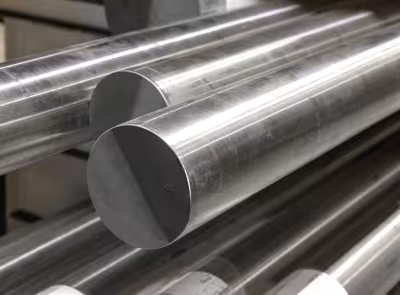
B‑16 alloy steel stands out as a high‑performance, chromium‑molybdenum alloy engineered for exceptional strength, toughness, and reliability in demanding environments. Known for its deep hardenability and impressive fatigue resistance, B‑16 is often selected for components that must endure high stress, shock loading, or continuous cyclic forces. Its chemistry allows it to maintain mechanical integrity even after heat treatment, making it a favorite for critical fasteners, high‑strength bolts, and heavy‑duty industrial hardware. Beyond raw strength, B‑16 offers solid machinability and predictable performance, giving manufacturers a material that balances durability with production efficiency.
- Inventory & Specs
- Chemical Composition
- Physical Properties
- Mechanical Properties
- Datasheet
- Additional Info
- FAQs
Inventory Size Ranges for B-16 Alloy Steel
| Type | Size Range | ASTM | Get a Quote |
|---|---|---|---|
| Bar | 1.000" - 7.000" | ASTM A193 Grade B16 (w/ supplement of S2 charpy impact test) | Get a Quote |
Characteristics of B-16
B-16 was engineered for exceptional strength and is able to maintain its high tensile properties even after heat treatment, making it useful in demanding industrial environments. Thanks to its chromium‑molybdenum alloy composition, B‑16 can be uniformly hardened through thick sections. This ensures consistent mechanical properties, reliable heat-treat responses, and strong resistance to deformation under load. B‑16’s alloy structure gives it superior fatigue strength, helping prevent failure in applications involving vibration, pressure fluctuations, or repeated stress cycles. Even at high hardness levels, B-16 retains good toughness. It’s not a high‑temperature alloy like Inconel, but it performs well in the temperature ranges typical for industrial bolting. B-16 requires coatings or plating when used in corrosive environments. Its corrosion resistance is similar to other Cr‑Mo alloy steels.
Working with B-16
B-16 machines reasonably well in the annealed condition, which is when most threading and shaping should be done. Once heat‑treated, the material becomes significantly harder, so post‑treat machining is avoided unless absolutely necessary. Heat treatment is central to achieving B‑16’s final properties. It is typically quenched and tempered to reach high tensile and yield strength. Uniform heating and controlled quenching are important to avoid distortion in long bolts or studs. Tempering restores toughness and reduces brittleness, giving the alloy its characteristic balance of strength and ductility.
B‑16 is not commonly welded because it is usually used in fastener form, and welding can compromise its heat‑treated properties. If welding is unavoidable, preheat and post‑weld heat treatment are required to reduce cracking risk.
Other industry standards we comply with:
- S6 stress relieving by AOD-ESR melt
- GE-B5F5
- EN 10204
- Hot worked, solution treated (annealed), then descaled
Common Trade Names
- B16 alloy
- B16 steel
- B16 bolt material
Industry Applications for B-16 Alloy Steel
- Power generation
- Bolting
Chemical Composition
| Element | Min | Max | |
|---|---|---|---|
| C | Carbon | 0.42 | 0.50 |
| Cr | Chromium | 0.80 | 1.15 |
| Mn | Manganese | 0.45 | 0.70 |
| Mo | Molybdenum | 0.45 | 0.65 |
| P | Phosphorus | - | 0.025 |
| V | Vanadium | 0.25 | 0.35 |
| S | Sulfur | - | 0.025 |
| Al | Aluminum | - | 0.015 |
| Si | Silicon | 0.20 | 0.35 |
Physical Properties
- Density: 0.283 lb/in3
- B16 alloy is typically hardened by oil quenching and tempering after the part has reached room temperature
- In diameters over 7", water quenching may be used to meet Charpy impact properties
Mechanical Properties
Hardness
Generally, B16 alloy steel bar is supplied in the quenched and tempered condition where the hardness is normally Rc 35-43. In the annealed condition, hardness is typically 187 BHN.
Machinability
Generally supplied in the quenched and tempered condition, machinability is similar to standard AISI alloys such as 4340.
Datasheet
Additional Info
A Brief History of B-16
B-16 is a chromium-molybdenum-vanadium alloy steel developed for high-strength, high-temperature bolting applications. The broader B-series bolting and materials standards date back to the early 20th century efforts to standardize high-pressure piping components. The alloy later became formally defined within ASTM A193 as industries demanded bolting capable of withstanding elevated temperatures, pressure, and creep conditions, notable in power generation and petrochemical environments.
How B-16 was Developed
B-16 evolved as an enhanced variant of chromium-molybdenum steels, with vanadium added to improve high-temperature strength, creep resistance, and stability. The development process for this alloy involved advancing heat-treatment practices, particularly quench-and-temper cycles at 1200°F (650°C) to achieve consistent mechanical performance.
Early Applications of B-16
When first standardized, B‑16 was used primarily in high‑strength fasteners for demanding industrial environments. Key early uses included power generation turbines, high-temperature bolted joints, pressure vessels, flanges, and valves. These applications established the alloy as a trusted fastener material in sectors requiring durable, creep-resistant bolting.
How B-16 is Used Today
B-16 remains widely utilized in industries where high-temperature strength, oxidation resistance, and reliability are critical.
- Power Generation: Boilers, heat exchangers, steam turbines
- Petrochemical: High-pressure reactor systems, refinery heaters, chemical processing equipment
Your Trusted Supplier of B-16
United Performance Metals supplies B-16 bar sizes 1.000" - 7.000".
Product FAQs
B‑16 is a chromium‑molybdenum alloy steel specifically formulated for high‑strength bolts, studs, and fasteners used in demanding industrial environments. It offers high tensile strength, excellent hardenability, and strong fatigue resistance.
B-16 offers high strength with good toughness, excellent fatigue resistance, reliability when heat-treating, and good performance at moderately elevated temperatures.
B‑16 is typically quenched and tempered to achieve its final mechanical properties. This process gives it high tensile strength, improved ductility, strong fatigue resistance, and dimensional stability.