
302 Stainless Steel Sheet, Coil & Plate - AMS 5516, UNS S30200
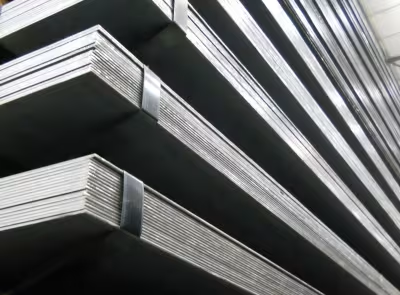
302 stainless steel is an extremely tough, ductile grade that demonstrates superior corrosion resistance. 302 SS is non-magnetic, and it is not hardenable by heat treating. While it can be cold worked to increase hardness, it will also cause it to become slightly magnetic. It is generally used in the annealed condition and is noted for its ease of fabrication and formability. Cold working will significantly increase hardness. However, it maintains ductility and can be drawn, spun, and upset. This product is ideal for uses such as stamping and forming of products like flat washers from sheet material. It is corrosion resistant in many environments, and its higher level of corrosion resistance make it a great choice for the food and beverage industry. Some of the major applications for 302 stainless steel include heat exchangers, piping, and architecture and structural applications.
- Inventory & Specs
- Chemical Composition
- Physical Properties
- Mechanical Properties
- Datasheet
- Additional Info
- FAQs
Inventory Size Ranges for 302
| Type | Size Range | AMS Standards | ASTM | UNS | ASME | Get a Quote |
|---|---|---|---|---|---|---|
| Coil | 0.010" - 0.125" | AMS 5516 | ASTM A 666, ASTM A 240 | UNS S30200 | ASME SA 240, ASME SA 666 | Get a Quote |
| Sheet | 0.010" - 0.125" | AMS 5516 | ASTM A 666, ASTM A 240 | UNS S30200 | ASME SA 240, ASME SA 666 | Get a Quote |
| Precision Reroll Strip | 0.0008" - 0.015" | Get a Quote |
Characteristics of 302
302 contains slightly more carbon than 304, helping it achieve higher tensile and yield strength when cold-rolled. The typical tensile strength is up to 185 ksi depending on temper and yield strength up to 140 ksi. 302 has excellent fatigue resistance and corrosion resistance. This alloy is resistant to atmospheric corrosion, mild chemical, and fresh water. In the annealed form, 302 is non-magnetic. Cold-worked 302 becomes magnetic due to strain-induced martensite. This makes it useful for springs and fasteners where magnetism is acceptable or desired. 302 maintains strength and oxidation resistance at elevated temperatures. It is Useful up to ~1600°F (870°C).
Working with 302
302 is an austenitic stainless steel very similar to 304, but with slightly higher carbon levels. Due to this, 302 demonstrates excellent formability in the annealed state and good corrosion resistance. This alloy work hardens aggressively and cannot be hardened by heat treatment. When machining 302, it is important to know that it work hardens fast, so tools must stay ahead of the cut. 302 stainless steel is an excellent choice for forming and deep drawing, making it excellent for the production of springs, clips, and formed parts. After heavy forming, 302 stainless becomes magnetic and significantly harder. 302 offers good weldability with standard austenitic stainless processes, but its high carbon levels increase the risk of carbine precipitation which can reduce corrosion resistance in the heat-affected zone.
Other industry standards we comply with:
- PWA-LCS
- GE Aircraft Engine (GT193)
- GE Aviation S-SPEC-35 AeDMS S-400
- RR SABRe Edition 2
- DFARS Compliant
Common Trade Names
- ATI 302 (™ Allegheny Technologies)
Industry Applications for 302
- Food and beverage industry
- Pressure containing applications
- Sanitary or cryogenic applications
Chemical Composition
| Element | Min | Max | |
|---|---|---|---|
| C | Carbon | - | 0.15 |
| Mn | Manganese | - | 2.0 |
| P | Phosphorus | - | 0.045 |
| S | Sulfur | - | 0.03 |
| Si | Silicon | - | 0.75 |
| Cr | Chromium | 17.000 | 19.000 |
| Ni | Nickel | 8.000 | 10.000 |
| Al | Aluminum | - | 0.1 |
Physical Properties
| Property | Value |
|---|---|
| Density | 0.29 lb/in3 (8.03 g/cm3) |
| Modulus of Elasticity in Tension | 29x106 psi (200 GPa) |
| Magnetic Permeability | 1.02 Max @ 200 H |
| Temperature Range | Mean Coefficient of Thermal Expansion | ||
|---|---|---|---|
| °C | °F | mm/mm°C | in/in/°F x 10? |
| 20 - 100 | 68 - 212 | 16.6 · 10-6 | 9.2 · 10-6 |
| 20 - 870 | 68 - 1600 | 19.8 · 10-6 | 11 · 10-6 |
| Temperature Range | W/m·K | Btu/(hr/ft²/hr/°F/ft) | |
|---|---|---|---|
| °C | °F | ||
| 100 | 212 | 16.3 | 9.4 |
| 500 | 932 | 21.4 | 12.4 |
| Temperature Range | J/kg°K | Btu/lb/°F | |
|---|---|---|---|
| °C | °F | ||
| 0-100 | 32-212 | 500 | 0.12 |
| Temperature Range | microhm-cm | microhm-in | |
|---|---|---|---|
| °C | °F | ||
| 20 | 68 | 72 | 28.3 |
| 100 | 212 | 78 | 30.7 |
| 200 | 392 | 86 | 33.8 |
| 400 | 752 | 100 | 39.4 |
| 600 | 1112 | 111 | 43.7 |
| 800 | 1472 | 121 | 47.6 |
| 900 | 1652 | 126 | 49.6 |
Mechanical Properties
| Property | 302, 304 | 304L | 305 |
|---|---|---|---|
| 0.2% Offset Yield Strength, psi (MPa) | 30,000 (205) | 25,000 (170) | 25,000 (170) |
| Ultimate Tensile Strength, psi (MPa) | 75,000 (515) | 70,000 (485) | 70,000 (485) |
Datasheet
Additional Info
Brief History of 302
302 stainless steel is one of the original austenitic chromium‑nickel stainless steels, developed in the early‑to‑mid 20th century as part of the foundational 18‑8 stainless family. 302 was one of the earliest commercial alloys in this family, preceding and influencing the development of 304. It was designed to provide excellent corrosion resistance, good formability, and high strength through cold working. As stainless steel adoption grew in architecture, food processing, and industrial equipment, 302 became a widely used, general‑purpose alloy.
How 302 was Developed
302 was engineered as part of the first generation of austenitic stainless steels, with the goal of creating a versatile, corrosion‑resistant alloy suitable for a wide range of applications. The alloy uses the classic 18‑8 composition, but with slightly higher carbon content than 304. The higher carbon improves strength and hardness after cold working and the austenitic structure provides non-magnetic behavior when annealed, as well as high toughness and excellent corrosion resistance. 302 essentially served as a stepping stone to 304, which reduced carbon to improve weldability.
Early Applications of 302
Because of its corrosion resistance and formability, 302 quickly became a popular choice across many industries. From the 1930s-1960s, this alloy was commonly used for food processing equipment, kitchenware and appliances, architectural trim and panels, spring and wire products, chemical processing equipment, automotive and tripartition components, and fasteners. Its ability to be drawn into wire and formed into complex shapes made it especially valuable in early mass‑manufacturing.
How 302 is Used Today
Although 304 has largely replaced 302 in many applications, 302 still has a strong presence in industries that benefit from its higher carbon content and superior cold‑work hardening. Modern applications include:
- Springs & Wire Products: Compression springs, extension springs, retaining rings, wire forms, medical and industrial wire
- Industrial & Manufacturing: Conveyor belts, fasteners, clamps, brackets, precision stamping
- Food & Consumer Products: Food processing equipment, kitchen tools, appliance components
- Architecture & Construction: Decorative panels, elevator trim, building hardware
- Chemical & Environmental: Mild chemical processing, tanks, vessels, non-marine corrosion resistant components
Your Trusted Provider for 302 Stainless Steel
UPM stocks 302 stainless steel in coil and sheet 0.010" - 0.125" and precision rerolled strip 0.0008" - 0.015". This product is ideal for uses such as stamping and forming of products like flat washers from sheet material. It is corrosion resistant in many environments, and its higher level of corrosion resistance make it a great choice for the food and beverage industry. Some of the major applications for 302 stainless steel include heat exchangers, piping, and architecture and structural applications.
Product FAQs
302 offers excellent corrosion resistance, high strength when cold worked, and good formability. This alloy is non-magnetic when in the annealed state.
302 has a slightly more carbon in its chemical makeup, giving it higher strength after cold working. Grade 304 has better weldability and slightly better corrosion resistance.