
Alloy 188 Cobalt Sheet, Coil & Bar - AMS 5608, 5772
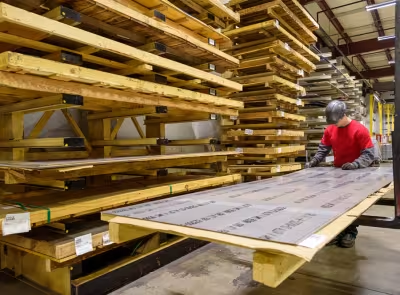
Udimet Alloy® 188 is a high‑temperature powerhouse known for its exceptional strength, oxidation resistance, and metallurgical stability in extreme environments. Built on a cobalt‑nickel‑chromium‑tungsten foundation, it maintains mechanical integrity at temperatures where many nickel alloys begin to soften, making it a favorite for aerospace hot‑section components, gas‑turbine hardware, and combustion‑zone parts. Its resistance to thermal fatigue, oxidation, and sulfidation allows it to thrive in severe cyclic environments, while its toughness and weldability give engineers a reliable, long‑service‑life material for mission‑critical applications.
- Inventory & Specs
- Chemical Composition
- Physical Properties
- Mechanical Properties
- Datasheet
- Additional Info
- FAQs
Inventory Size Ranges for 188
| Type | Size Range | AMS Standards | UNS | Get a Quote |
|---|---|---|---|---|
| Coil | 0.020" - 0.080" | AMS 5608, AMS 5772 | UNS R30188 | Get a Quote |
| Sheet | 0.020" - 0.080" | AMS 5608, AMS 5772 | UNS R30188 | Get a Quote |
| Bar | 0.375" - 3.000" | AMS 5608, AMS 5772 | UNS R30188 | Get a Quote |
Characteristics of Alloy 188
Alloy 188 is non-magnetic. It has good high temperature strength up to 1800ºF (982°C) and good oxidation resistance up to 2100ºF (1149°C). This alloy performs well in continuous high temperature service and has excellent oxidation, spalling and corrosion resistance, achieved through the addition of chromium in combination with a minute amount of lanthanum. The lanthanum addition produces a tenacious, protective oxide scale at high temperatures. This alloy also maintains its ductility at cryogenic temperatures, but strength levels are increased substantially.
Working with Alloy 188
Alloy 188 is workable, but it work-hardens rapidly, so machining requires careful control. It has good forming characteristics and can be forged, hot‑worked, or cold‑worked, but work‑hardens very rapidly, requiring frequent annealing during complex forming operations. Supplied in the solution-annealed condition for best machinability. Alloy 188 is more formable than many nickel‑based superalloys. This alloy can be hot-worked or cold-worked using conventional techniques. Cold-working requires frequent annealing due to rapid work hardening. Hot-working is typically performed at elevated temperatures to reduce load and improve ductility. Alloy 188 is typically supplied solution heat‑treated at 2150 °F and rapidly air‑ or water‑quenched to achieve optimum properties. Alloy 188 has good weldability, which is one reason it is widely used in gas‑turbine hot sections.
Other industry standards we comply with:
- B50TF74
- PWA-LCS
- GE Aircraft Engine (GT193)
- GE Aviation S-SPEC-35 AeDMS S-400
- RR SABRe Edition 2
- DFARS Compliant
Common Trade Names
- Udimet Alloy 188 (® Special Metals )
- Haynes 188 Alloy (® Haynes International)
- ATI 188 (™ Allegheny Technologies)
Industry Applications for 188
- Gas turbine operations
- Combustors
- Flame holders
- Liners
- Transition ducts
- Exhaust frames
Chemical Composition
| Element | Min | Max | |
|---|---|---|---|
| C | Carbon | 0.05 | 0.15 |
| Mn | Manganese | - | 1.25 |
| Si | Silicon | 0.20 | 0.50 |
| Cr | Chromium | 20.0 | 24.0 |
| Ni | Nickel | 20.0 | 24.0 |
| W | Tungsten | 13.0 | 16.0 |
| La | Lanthanum | 0.02 | 0.12 |
| B | Boron | - | 0.015 |
| Fe | Iron | - | 3.0 |
| Co | Cobalt | - | Balance |
Physical Properties
| Property | Value |
|---|---|
| Density | 0.330 lb/in³ 9.14 g/cm³ |
| Melting Range | 2375-2425 °F 1300-1330 °C |
| Specific Heat | 0.097 at 70 °F, Bru/lb °F 405 at 21 °C, J/kg °C |
| Permeability | 1.0007 at 200 oersted |
| Coefficient of Expansion | 6.6 0-200 °F, 10¯⁶ in/in·°F |
| Thermal conductivity | 84 Btu·in/ft²·h·°F W/wm·°C |
| Electrical Resistivity | 613 ohm·circ mil/ft 102.0 microhm-cm |
Mechanical Properties
| Yield Strength | Tensile Strength | Elongation % | ||
|---|---|---|---|---|
| ksi | MPa | ksi | MPa | |
| 65 | 446 | 140 | 963 | 55 |
Datasheet
Additional Info
A Brief History of Alloy 188
Alloy 188 was developed during the expansion of high‑temperature aerospace and industrial gas turbine technology in the mid‑20th century. As turbine inlet temperatures increased, engineers needed alloys that could maintain strength at extreme temperatures, resist oxidation and sulfidation, withstand thermal cycling and creep, and offer good formability for complex combustor and duct shapes. Haynes International became a leading producer of this alloy, and Alloy 188 (UNS R30188) emerged as one of the most oxidation‑resistant cobalt superalloys available.
How Alloy 188 Was Developed
Alloy 188 was engineered as a solid‑solution‑strengthened cobalt‑nickel‑chromium‑tungsten alloy with a small lanthanum addition. Key metallurgical design features included cobalt‑based matrix for high‑temperature strength, chromium (20–24%) for oxidation resistance up to 2000 °F, tungsten (13–15%) for solid‑solution strengthening and creep resistance, nickel (20–24%) for stability and toughness, and lanthanum to form a tenacious, protective oxide scale that improves oxidation resistance. The alloy was designed to outperform earlier cobalt alloys in both oxidation resistance and fabricability.
Early Applications of Alloy 188
Because of its excellent high‑temperature properties, Alloy 188 was quickly adopted in gas turbine combustors, flame holders, transition ducts, combustion liners, and afterburner components. These applications used Alloy 188 due to its oxidation resistance and high temperature strength.
How Alloy 188 is Used Today
Alloy 188 remains a major high‑temperature material in aerospace, energy, and industrial sectors.
- Aerospace: Combustion cans, liners, flame holders, transition ducts
- Power Generation: Gas turbines, hot section components
Your Trusted Supplier of Alloy 188 Cobalt
United Performance Metals offers Alloy 188 coil and sheet 0.020" - 0.080" and bar 0.275" - 3.000". This alloy is commonly used in the fabrication of gas turbine components such as combustion cans and transition ducts.
Product FAQs
Cobalt alloy 188 offers a unique balance of strength, corrosion resistance, and fabrication abilities, making is a popular choice in the aerospace, defense, space, and power generation industries for jet engines, turbines, and other high-temperature systems.
Its strength comes from solid‑solution strengthening by tungsten and nickel, carbide precipitation (M6C, M23C6) at high temperatures, and a stable face‑centered‑cubic (FCC) cobalt matrix.
Alloy 188 offers superior oxidation resistance at 1800–2000 °F and better creep resistance. The cost of Alloy 188 is typically higher due to its cobalt base.