
Alloy 422 Stainless Steel Bar - AMS 5655
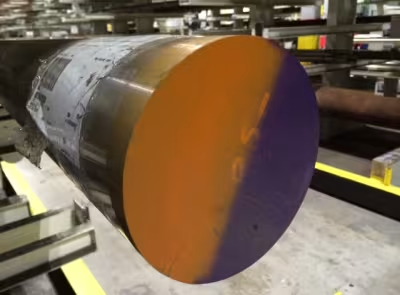
422 stainless steel stands out as a high‑strength, heat‑treatable martensitic stainless steel engineered for demanding high‑temperature environments. With alloying elements like chromium, molybdenum, tungsten, and vanadium, it delivers a rare combination of oxidation resistance, creep strength, and mechanical stability up to around 1200°F. That balance makes it a workhorse material for steam and gas turbines, aerospace hardware, high‑temperature bolting, and hot‑section components where reliability under thermal stress is non‑negotiable. Fully magnetic and capable of achieving impressive hardness through heat treatment, 422 offers a cost‑effective alternative to nickel‑based superalloys while still providing the durability and performance needed for critical rotating and structural parts.
- Inventory & Specs
- Chemical Composition
- Physical Properties
- Mechanical Properties
- Datasheet
- Additional Info
- FAQs
Inventory Size Ranges for 422
| Type | Size Range | AMS Standards | ASTM | UNS | ASME | Get a Quote |
|---|---|---|---|---|---|---|
| Bar | 0.500" - 13.000" | AMS 5655 | ASTM A 176, ASTM A 565 | UNS S42200 | AMSE SA 176 | Get a Quote |
Characteristics of 422
Because of it is martensitic, 422 stainless steel is fully magnetic in all conditions. 422 is specifically designed for service up to 1200°F (649°C), maintaining its strength at elevated temperatures. 422 offers excellent creep rupture properties at high heat and provides good scaling and oxidation resistance. This makes it ideal for turbine and hot-section components. This alloy offers moderate corrosion resistance and good oxidation resistance at high temperatures. It is not intended for environments requiring maximum corrosion resistance, but it performs well in hot, oxidizing conditions.
Working with 422
422 machines similarly to other high-strength martensitic stainless grades, but its alloying additions (W, Mo, V) make it abrasive and work hardening. This alloy is best machined in the annealed condition and requires carbide tooling and aggressive cooling. Welding 422 requires more care than austenitic stainless steels. 422 is air-hardening, so it can crack if welded without proper heat control. Preheat and post-weld treatment are typically required and matching filler metals are recommended. 422 is not as formable as austenitic stainless grades, limiting its cold-formability due to high strength. Hot working is preferred and requires controlled heating to avoid cracking. When heat treating 422, typical steps include annealing for machinability, hardening for strength, and tempering to achieve desired toughness and creep resistance. 422's heat treat response in one of the reasons it is used in turbine blades and high-temperature bolting.
Other industry standards we comply with:
Common Trade Names
- 422 Stainless
- Alloy 422
- 422
Industry Applications for 422
- Power generation
- Compressors
- Steam turbines
- Aircraft parts
- High-temperature bolting
Chemical Composition
| Element | Min | Max | |
|---|---|---|---|
| C | Carbon | 0.20 | 0.25 |
| Cr | Chromium | 11.50 | 13.50 |
| P | Phosphorus | - | 0.040 |
| Mo | Molybdenum | 0.75 | 1.25 |
| S | Sulfur | - | 0.030 |
| W | Tungsten | 0.75 | 1.25 |
| Si | Silicon | - | 1.00 |
| V | Vanadium | 0.20 | 0.50 |
| Mn | Manganese | - | 1.00 |
| Fe | Iron | - | Balance |
Physical Properties
| Property | Value |
|---|---|
| Density | 0.280 lb/in3 |
| Hardening Annealed | Rc 21/25 |
| Hardening Quenched and Tempered | Rc 45/50 |
Heat treatment is sensitive as the alloy is very susceptible to cracking.
Mechanical Properties
422 bar is readily machinable in the annealed condition with machining characteristics similar to those of alloy 420 stainless steel.
Datasheet
Additional Info
A Brief History of 422
422 stainless steel was developed in the mid‑20th century as industries demanded steels that could withstand high temperatures, high stress, and corrosive environments, especially in the rapidly expanding aerospace and power‑generation sectors. It belongs to the martensitic stainless steel family, but unlike traditional martensitic grades (like 410 or 420), 422 was engineered to deliver higher creep strength, better oxidation resistance, improved high temperature stability, and stronger mechanical properties at elevated temperatures. It became one of the earliest stainless steels specifically tailored for turbine engine components.
How 422 Was Developed
422 was created by modifying the chemistry of earlier martensitic stainless steels and adding elements that improve high‑temperature performance. Metallurgist created 422 through high chromium (~12%) for oxidation and corrosion resistance, tungsten and molybdenum for creep strength and hot hardness, vanadium for carbide strengthening, carbon and nitrogen to stabilize martensite and improve strength, and nickel to improve toughness. The result was a stainless steel that could be heat‑treated to high strength while still maintaining stability at temperatures up to ~1200°F (650°C). This made 422 one of the first “bridge alloys” between stainless steels and early superalloys.
Early Applications of 422
Because of its high‑temperature strength and oxidation resistance, 422 was used for aircraft gas turbine engines, steam turbine components, compressor blades and vanes, rotors and turbine wheels, bolting and fasteners in high heat environments, and combustion section hardware. It was especially valued in early jet engines, where temperatures and stresses were increasing faster than materials technology could keep up.
How 422 is Used Today
While newer superalloys have taken over many extreme‑temperature applications, 422 stainless still plays an important role in modern industry. Modern applications include stream turbine blades and buckets, gas turbine components, high temperature bolting, valve components, pump shafts and rotors, and combustion hardware. The alloy remains popular due to its cost-effective balance of high temperature strength, oxidation resistance, heat-treatability, toughness, and machinability relative to superalloys.
Your Trusted Supplier for 422 Stainless
United Performance Metals offer 422 bar 0.500" - 13.000". Typical applications for this product include buckets and blades in steam turbines, high temperature bolting and valve and valve trim.
Product FAQs
Compared to grades like 410 and 420, 422 contains tungsten, molybdenum, vanadium, and nickel, which significantly improves high temperature strength, creep resistance, oxidation resistance, and hardenability.
422 performs well in continuous service up to roughly 1200°F (650°C). Its alloying additions help it retain strength and resist oxidation in hot, high‑stress environments.