
301 Full Hard Tempered Stainless Steel Sheet & Coil - AMS 5519
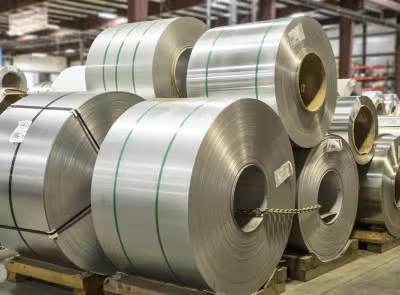
301 Full Hard is an austenitic stainless steel which differs from other forms of 301 offered by United Performance Metals in that it has been cold rolled to its full hard condition. This increases the metal's attractiveness for forming and increases its fatigue life. In its full hard condition, type 301 has a tensile strength of 185,000 PSI minimum, and a minimum yield strength of 140,000 PSI. The combination of hardness and toughness make it ideal for springs.
Due to its high strength and partially martensitic structure developed through cold working, 301 FH can be more challenging to fabricate than softer stainless steel tempers. Cutting operations typically require robust tooling and optimized processing parameters. Laser cutting offers excellent edge quality and production efficiency, while waterjet cutting is ideal when eliminating heat-affected zones is critical. Mechanical shearing is suitable for thinner gauges but generally requires higher cutting forces due to the material's elevated hardness and strength.
301 FH is commonly supplied with a bright finish and can be further enhanced through polishing, brushing, or passivation. Passivation helps remove surface contaminants and promotes the formation of the alloy's protective chromium-rich oxide layer, supporting long-term corrosion resistance and appearance after fabrication.
- Inventory & Specs
- Chemical Composition
- Physical Properties
- Mechanical Properties
- Datasheet
- Additional Info
- FAQs
Inventory Size Ranges for 301 FH
| Type | Size Range | AMS Standards | ASTM | UNS | ASME | Get a Quote |
|---|---|---|---|---|---|---|
| Coil | 0.010" - 0.098" | AMS 5519 | ASTM A 666 | UNS S30100 | ASME SA 666 | Get a Quote |
| Sheet | 0.010" - 0.098" | AMS 5519 | ASTM A 666 | UNS S30100 | ASME SA 666 | Get a Quote |
| Precision Reroll Strip | 0.0008" - 0.015" | AMS 5519 | UNS S30100 | Get a Quote |
Characteristics of 301 FH
Cold rolling to the FH (full hard) condition produces tensile strength ~185,000 psi minimum and yield strength ~140,000 psi minimum. Strength increases rapidly with additional cold work due to its very high work-hardening rate. This makes 301 FH one of the strongest commercially available austenitic stainless steel. Cold work transforms some austenite into martensite, making 301 FH magnetic, unlike annealed 301 or 304. The corrosion resistance of 301 FH is comparable to other chromium-nickel stainless steels in atmospheric conditions. This grade has slightly lower corrosion resistance than 304 due to lower nickel content. 301 Fh has moderate heat resistance and good oxidation resistance up to 1550°F. It is not recommended for continuous service above 1600°F.
Working with 301 FH
301 FH is one of the least formable stainless tempers. It is chosen for strength, not ease of fabrication. 301 FH has minimal elongation and very high tensile strength, meaning forming must be limited and carefully controlled. If forming, simple bends with large bend radii are possible, as well as light roll-forming and shallow forming operations. Machining 301 FH is challenging because of its hardness and tendency to work-harden. It is recommended to use sharp carbide tooling, keep feeds high and speeds moderate, avoid dwelling, and use coolant to control heat and reduce galling. Welding is possible but not recommended for critical corrosion resistant applications. If welding, use low-heat input processes, expect to lose the full hard properties near the weld, and consider post-weld pickling or passivation.
Other industry standards we comply with:
- EN 1.4310
- PWA-LCS
- GE Aircraft Engine (GT193)
- GE Aviation S-SPEC-35 AeDMS S-400
- RR SABRe Edition 2
- DFARS Compliant
Common Trade Names
- ATI 301 Full Hard (™ Allegheny Technologies)
Industry Applications for 301 FH
- Aircraft structural parts
- Trailer bodies
- Architectural (roof drainage/door frames, etc.)
- Auto body trim and wheel covers
- Utensils and tablewear
- Conveyor parts
Chemical Composition
| Element | Min | Max | |
|---|---|---|---|
| C | Carbon | - | 0.15 |
| Mn | Manganese | - | 2.00 |
| P | Phosphorus | - | 0.045 |
| S | Sulfur | - | 0.03 |
| Si | Silicon | - | 1.00 |
| Cr | Chromium | 16.00 | 18.00 |
| Ni | Nickel | 6.000 | 8.000 |
| N | Nitrogen | - | 0.10 |
Physical Properties
| Property | Value |
|---|---|
| Density | 0.2850 lb/in3 (7.88g/cm3) |
| Melting Range | 2250 - 2950°F (1399 - 1421°C) |
| Specific Gravity | 8.03 |
| Modulus of Elasticity in Tension | 28x106 psi (193 GPa) |
| Magnetic Permeability | 1.02 Max @ 200 H |
| Temperature Range | Coefficients | ||
|---|---|---|---|
| °C | °F | cm/cm°C | in/in/°F |
| 20-100 | 68-212 | 16.6·10-6 | 9.2·10-6 |
| 20-300 | 68-572 | 17.6·10-6 | 9.8·10-6 |
| 20-500 | 68-932 | 18.6·10-6 | 10.3·10-6 |
| 20-700 | 68-1292 | 19.5·10-6 | 10.8·10-6 |
| 20-871 | 68-1600 | 19.8·10-6 | 11.0·10-6 |
| Temperature Range | Coefficients | ||
|---|---|---|---|
| °C | °F | W/m·K | Btu/(hr/ft²/hr/°F/ft) |
| 20-100 | 68-212 | 16.30 | 9.40 |
| 20-500 | 68-932 | 21.40 | 12.4 |
| Temperature Range | J/kg°K | Btu/lb/°F | |
|---|---|---|---|
| °C | °F | ||
| 0-100 | 32-212 | 500 | 0.12 |
| Temperature Range | microhm-cm | microhm-in | |
|---|---|---|---|
| °C | °F | ||
| 20 | 68 | 72 | 28.3 |
| 100 | 212 | 78 | 30.7 |
| 200 | 392 | 86 | 33.8 |
| 400 | 752 | 100 | 39.4 |
| 600 | 1112 | 111 | 43.7 |
| 800 | 1472 | 121 | 47.6 |
| 900 | 1652 | 126 | 49.6 |
Mechanical Properties
| Condition | Tensile Strength, Min. | 0.2% Yield Strength, Min. | Elong. In 2" (50mm) | ||
|---|---|---|---|---|---|
| Ksi | MPa | Ksi | MPa | %, Min. | |
| Annealed | 75 | 515 | 30 | 205 | 40 |
| 1/4 Hard | 125 | 862 | 75 | 517 | 25 |
| 1/2 Hard | 150 | 1034 | 110 | 758 | 18* |
| 3/4 Hard | 175 | 1207 | 135 | 931 | 12* |
| Full Hard | 185 | 1276 | 140 | 965 | 9* |
* Value shown for thickness greater than 0.015 in. (.038mm).
Datasheet
Additional Info
A Brief History of 301 FH
301 stainless steel was introduced as part of the 300‑series austenitic stainless steels, designed to offer a balance of corrosion resistance, formability, and mechanical strength. The Full Hard (FH) temper emerged as industries began requiring maximum tensile strength from cold‑worked stainless sheet without relying on heat treatment. 301 FH became widely used because it achieves very high strength through cold reduction alone, it retains good corrosion resistance typical of chromium-nickel stainless, and it offers a bright, attractive surface, making it suitable for visible structural components.
How 301 FH Was Developed
301 FH evolved from the base 301 alloy by optimizing:
- Cold-Work Hardening Behavior: 301 has one of the highest work‑hardening rates among austenitic stainless steels. By increasing cold reduction, manufacturers created the Full Hard temper, which maximizes tensile and yield strength.
- Temper Rolling Technology: Advances in precision rolling enabled consistent production of high-strength tempers, with FH representing the highest cold-worked condition.
Early Applications of 301 FH
Early adopters were industries that needed strong, thin, corrosion‑resistant metal that could be formed and then retain high strength. Common early uses included springs, aircraft components, automotive trim and structurual reinforcements, architectural and decorative panels, fasteners, rail transit components. Its combination of strength and appearance made it ideal for both functional and aesthetic applications.
How 301 FH is Used Today
301 FH remains widely used across modern industries because of its high strength‑to‑weight ratio, good corrosion resistance, and excellent fatigue performance.
- Automotive: Structural reinforcements, seatbelt components, railcar panels, exhaust system brackets
- Aerospace: Springs, clamps, brackets, lightweight structural parts
- Architecture: Decorative trim, elevator doors and panels, structural supports
- Industrial: Springs, washers, conveyor components, fasteners, high-strength shims
- Consumer Products: Appliance components, hand tools, knife blades
Your Trusted Supplier of 301 FH
United Performance Metals supplies coil and sheet sizes 0.010" - 0.098" and precision rerolled strip sizes 0.0008" - 0.015".
Product FAQs
"FH" stands for 301 full hard, a temper produced by heavy cold-rolling that maximizes strength and hardness.
301 FH is hardened only by cold working, not by heat treatment.
301 FH has limited formability because it is already full hardened. For deep drawing or heavy forming, softer tempers such as 1/4 hard, 1/2 hard, annealed are preferred.
301 stainless has good oxidation resistance up to 1550°F, but is not recommended above 1600°F.