
Alloy A286 Steel - AMS 5737, AMS 5731, AMS 5732, AMS 5525
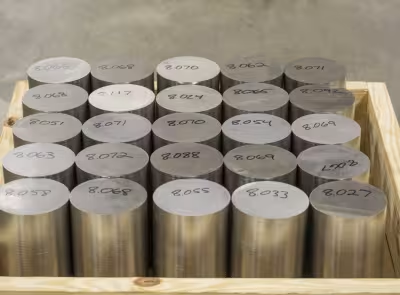
Incoloy® Alloy A‑286—also known as A286 stainless steel or UNS S66286—is a high‑strength, iron‑nickel‑chromium austenitic superalloy designed for applications requiring excellent mechanical strength and corrosion resistance at elevated temperatures. This alloy performs reliably up to 1300°F (704°C) and can support even higher temperatures in lower‑stress conditions. Its mechanical properties are developed through solution annealing and precipitation hardening, which produce a strong combination of tensile strength, creep resistance, and durability. A286 also offers excellent high‑temperature oxidation resistance, with stability in continuous service up to 1500°F (816°C) and intermittent service up to 1800°F (982°C).
A286 can achieve very high strength levels when aged after cold work, making it suitable for demanding applications such as high‑temperature fasteners, springs, jet engine components, automotive parts, turbine hardware, afterburner components, offshore equipment, and structural parts in elevated‑temperature service.
- Inventory & Specs
- Chemical Composition
- Physical Properties
- Mechanical Properties
- Datasheet
- Additional Info
- FAQs
Inventory Size Ranges for A286
| Type | Size Range | AMS Standards | ASTM | UNS | ASME | Get a Quote |
|---|---|---|---|---|---|---|
| Coil | 0.0200" - 0.1250" | ASTM A 453 | UNS S66286 | ASME SA 453 | Get a Quote | |
| Sheet | 0.0200" - 0.1250" | AMS 5525, AMS 5858 | ASTM A 453 | UNS S66286 | ASME SA 453 | Get a Quote |
| Bar | 0.250" - 6.000" | AMS 5731, AMS 5732, AMS 5737 | ASTM A 453, ASTM A 638 | UNS S66286 | ASME SA 453 | Get a Quote |
| Precision Reroll Strip | 0.0008" - 0.015" | Get a Quote |
Characteristics of A286
A286 contains chromium, nickel, and molybdenum levels similar to austenitic stainless steels, giving it comparable aqueous corrosion resistance. In elevated‑temperature environments—such as those found in gas turbines—it provides excellent corrosion resistance up to 1300°F (704°C) and strong oxidation resistance up to 1500°F (816°C) for continuous service. It also withstands intermittent oxidation up to 1800°F (982°C). These properties make A286 ideal for high‑temperature bolting, turbine machinery, and structural components that must resist scaling, oxidation, and thermal degradation over extended operating cycles.
Working with A286
A286 is most easily formed and fabricated in the solution‑treated condition, which enhances workability and reduces hardness during shaping or forming. Typical room‑temperature tensile properties for A286 solution treated at 1800°F (982°C) include high ductility and strong mechanical performance. The alloy can also be machined in both the solution‑annealed and aged conditions. For best results:
- Rough machine in the solution‑annealed state
- Finish machine after heat treatment (for improved dimensional accuracy)
A286 work hardens rapidly, so machining requires:
- Rigid setups
- Positive tool engagement
- Proper feed rates to avoid glazing or surface hardening
Carbide tooling is recommended for uninterrupted cuts, while high‑speed steel tools may be used for interrupted cuts or tight‑tolerance finishing.
Other industry standards we comply with:
- EN 1.4980
- DIN EN 10204 3.1
- PWA-LCS
- GE Aircraft Engine (GT193)
- GE Aviation S-SPEC-35 AeDMS S-400
- RR SABRe Edition 2
- DFARS Compliant
Common Trade Names
- Incoloy Alloy A286 (® Special Metals)
- Pyromet Alloy A-286 (® Carpenter Technology)
- ATI A286 (™ Allegheny Technologies)
- A286 Steel
Industry Applications for A286
- Jet engine components
- Fasteners
- Springs
- Bolts
- Flanges
- Blades
- Afterburners
- Automotive applications
- Offshore Oil Gas
- Moderate Corrosion Applications in Aqueous Solutions
- Non-magnetic Cryogenic Equipment
Chemical Composition
| Element | Min | Max | |
|---|---|---|---|
| C | Carbon | - | 0.08 |
| Mn | Manganese | - | 2.00 |
| P | Phosphorus | - | 0.025 |
| S | Sulfur | - | 0.025 |
| Si | Silicon | - | 1.00 |
| Cr | Chromium | 13.50 | 16.00 |
| Ni | Nickel | 24.00 | 27.00 |
| Mo | Molybdenum | 1.00 | 1.50 |
| Ti | Titanium | 1.90 | 2.35 |
| V | Vanadium | 0.10 | 0.50 |
| Al | Aluminum | - | 0.35 |
| B | Boron | 0.003 | 0.010 |
| Fe | Iron | - | Balance |
Physical Properties
| Property | Solution Treated | Solution Treated and Aged |
|---|---|---|
| Density | 0.286 lb./in3 (7.92 g/cm3) | 0.287 lb./in3 (7.94 g/cm3) |
| Specific Heat | 420 Joules kg°K (Btu/lb/°F) | - |
| Specific Gravity | 7.92 | 7.94 |
| Melting Range | 2500 - 2600 °F | 1370 - 1430 °C |
| Magnetic Permeability | 1.010 | 1.007 |
| Temperature Range | Linear Coefficients of Thermal Expansion · 10-6 | ||
|---|---|---|---|
| °C | °F | /°C | /°F |
| 21-93 | 70-200 | 16.5 | 9.17 |
| 21-204 | 70-400 | 16.8 | 9.35 |
| 21 - 316 | 70 - 600 | 17.0 | 9.47 |
| 21 - 427 | 70 - 800 | 17.4 | 9.64 |
| 21 - 538 | 70 - 1000 | 17.6 | 9.78 |
| 21 - 649 | 70 - 1200 | 17.8 | 9.88 |
| 21 - 760 | 70 - 1400 | 18.6 | 10.32 |
| Temperature Range | Coefficients | ||
|---|---|---|---|
| °C | °F | W/m·K | Btu/(hr/ft²/in/°F) |
| 150 | 302 | 15.1 | 8.7 |
| 300 | 572 | 17.8 | 10.3 |
| 500 | 932 | 21.8 | 12.6 |
| 600 | 1112 | 23.9 | 13.8 |
| Temperature | microhm-cm | |
|---|---|---|
| °C | °F | |
| 25 | 77 | 91.0 |
| 540 | 1004 | 115.6 |
| 650 | 1202 | 118.8 |
| 730 | 1346 | 120.1 |
| 815 | 1499 | 122.4 |
Mechanical Properties
Type A286 alloy is formed most easily in the solution treated condition. Typical room temperature tensile properties of material solution treated at 1800°F (982°C) are shown below.
| Property | Value |
|---|---|
| Yield Strength | 40,000 psi (275 MPa) |
| Ultimate Tensile Strength | 90,000 psi (620 MPa) |
| Elongation | 40% |
Datasheet
Additional Info
A Brief History of A286
A286—also known as Incoloy® A‑286, Alloy A286, UNS S66286, or Grade 660—is one of the earliest high‑performance iron‑nickel‑chromium superalloys developed specifically to address the limitations of traditional stainless steels in high‑strength, high‑temperature applications. For decades, stainless steels provided good corrosion resistance and moderate strength for fasteners and structural hardware, but they could not match the mechanical strength needed in aerospace, power‑generation, and high‑temperature automotive systems. Precipitation‑hardening stainless grades gained strength but often sacrificed corrosion resistance, while 4xx stainless steels offered strength at the cost of durability in corrosive environments. To solve this performance gap, A286 was developed as a next‑generation alloy that delivered both high strength and excellent corrosion resistance in elevated‑temperature environments.
How Nickel 600 Was Developed
Engineers sought a material that combined the corrosion resistance of austenitic stainless steels with the high‑temperature strength of alloy steels—one capable of resisting creep, oxidation, and stress‑rupture failures in demanding thermal environments. A286 accomplishes this through a carefully balanced composition of nickel, chromium, molybdenum, and titanium, which allows the alloy to be strengthened through solution annealing and precipitation hardening. These metallurgical mechanisms give A286 the ability to retain high strength up to 1000°F (538°C) and strong oxidation resistance up to 1500°F (816°C), while maintaining excellent corrosion resistance similar to high‑end stainless steels. Its ability to reach very high tensile strengths when aged after cold work quickly made A286 one of the most versatile superalloys for aerospace and industrial fasteners.
Early Applications of Nickel 600
As engine and turbine technologies evolved, A286 became a material of choice for critical hardware exposed to extreme heat, vibration, and mechanical loading. Early adoption focused heavily on high‑strength fasteners, where A286 outperformed 3xx stainless steels in both temperature capability and creep resistance. Manufacturing industries relied on A286 for:
- Hex bolts, nuts, screws, and washers
- High‑temperature structural fasteners
- Turbine wheels and low‑pressure turbine buckets
- Afterburner components and exhaust nozzle parts
- Aerospace and military engine hardware
- Automotive exhaust valves and manifold fasteners
Its combination of formability, long‑term strength retention, and resistance to oxidation made it invaluable in early aerospace engines, as well as in industrial and automotive thermal systems where stainless steels could not maintain performance under elevated temperature loads.
How Nickel 600 Is Used Today
Today, A286 remains a widely used and cost‑effective high‑temperature superalloy across aerospace, automotive, oil & gas, industrial turbine, and power‑generation markets. The alloy’s ability to maintain tensile strength, corrosion resistance, and creep stability at temperatures up to 1300°F (704°C) makes it ideal for aerospace, automotive, energy and industrial turbines, manufacturing, and heavy industry.
A286 is also favored because it can be cold‑worked for additional strengthening, hot‑worked to form larger fasteners or components, and machined more easily than many other nickel‑based superalloys such as Alloy 718—while still offering excellent mechanical reliability and oxidation resistance. Welding is typically preferred on thinner sections using materials supplied to specs such as AMS 5858, reducing susceptibility to hot cracking.
Your Trusted Supplier for Nickel 600
United Performance Metals is a leading distributor of A286 stainless steel in round bar, sheet, coil, strip, and precision rerolled strip certified to major industry specifications including AMS 5731, 5732, 5737, 5525, and 5858. With extensive expertise supporting fastener manufacturers, turbine producers, automotive OEMs, and high‑temperature industrial applications, UPM delivers A286 material cut to your exact specifications with our FIRSTCUT+® precision processing services. Whether you need high‑strength fastener stock, turbine‑grade material, or specialty strip for formed components, our team will help you source the right A286 alloy for the job.
Contact our team today for a quote or to learn how A286 can enhance performance, reliability, and thermal stability in your next application.