
316LS / 316LVM Surgical Stainless Steel Bar - ASTM F138
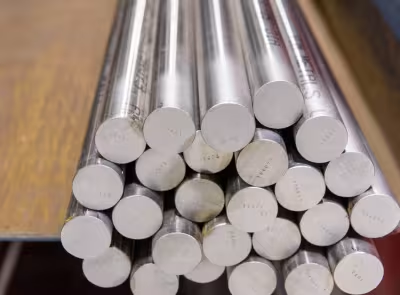
316LS/316LVM surgical steel is an electro-slag remelted (ESR) or vacuum arc remelted (VAR), low carbon, high nickel and molybdenum version of 316 stainless. The secondary premium melting step imparts improved cleanliness. The chemistry modifications are designed to maximize the corrosion resistance of this alloy and provide a ferrite-free microstructure. The alloy is nonmagnetic even after severe cold forming operations.
- Inventory & Specs
- Chemical Composition
- Physical Properties
- Mechanical Properties
- Datasheet
- Additional Info
- FAQs
Inventory Size Ranges for 316LS/316LVM
| Type | Size Range | ASTM | Get a Quote |
|---|---|---|---|
| Bar | 0.1875" - 0.4375" | ASTM F 138 | Get a Quote |
Characteristics of 316LS/316LVM
316LS is a low-sulfur, low-carbon version of 316L used for welding, machining, and improved corrosion resistance. 316LVM is vacuum melted 316L, resulting in extr5emely low impurities and excellent biocompatibility. Both alloys are variants of 316L stainless steel, modified for higher purity, better corrosion resistance, and enhanced performance in critical applications. These alloys is non-magnetic in the annealed condition and remains stable under cold working.
Working with 316LS/316LVM
Both alloys machine similarly to 316L, but 316LVM is noticeably cleaner, which improves consistency. Since these alloys are austenitic, they work harden quickly and require sharp tooling and controlled heat. 316LS/316LVM are excellent for welding applications due to their low carbon content which prevents carbide precipitation. These alloys both have high resistance to intergranular corrosion and 316LVM has reduced weld porosity due to its purity. Both alloys are highly formable and maintain toughness even at low temperatures. They are excellent for bending, deep drawing, spinning, and cold forming. Cold forming these alloys increases their strength and may introduce slight magnetism. 316LVM's purity improves consistency in micro-0forming and fine wire applications. Neither alloy can be hardened by heat treatment. Instead, they can be annealed at ~1900–2050°F to restore ductility after heavy cold work, followed by a rapid quench to maintain corrosion resistance. 316LVM responds very predictably due to its controlled chemistry.
Other industry standards we comply with:
Common Trade Names
- BioDur® 316LS
- 316 LVM Surgical Steel
Industry Applications for 316LS/316LVM
- Fracture Fixation Devices
- Bone Plates
- Screws
- Intramedullary Nails
- Surgical Implant Devices
- Surgical Instruments
Chemical Composition
| Element | Min | Max | |
|---|---|---|---|
| C | Carbon | - | 0.03 |
| P | Phosphorus | - | 0.03 |
| Si | Silicon | - | 0.75 |
| Ni | Nickel | 13.0 | 15.0 |
| Cu | Copper | - | 0.05 |
| Mn | Manganese | - | 2.00 |
| S | Sulfur | - | 0.01 |
| Cr | Chromium | 17.0 | 19.0 |
| Mo | Molybdenum | 2.25 | 3.0 |
| N | Nitrogen | - | 0.10 |
| Fe | Iron | - | Balance |
Physical Properties
| Property | Value |
|---|---|
| Specific Gravity | 7.95 |
| Density | 0.2870 lb/in3 |
| Mean Specific Heat 32-212°F | 1200 Btu/lb/°F |
| Electrical Resistivity 70°F | 445.0 Ohm-cir-mil/ft |
Mechanical Properties
| Diameter | Ultimate Tensile Strength | ||
|---|---|---|---|
| In. | Mm | Ksi | MPa |
| Up to 0.250 | Up to 6.3 | 175 | 1207 |
| 0.251 - 0.500 | 6.31-12.7 | 165 | 1138 |
| 0.501 - 1.000 | 12.71-25.4 | 155 | 1069 |
| 1.001 - 1.500 | 25.4-38.1 | 125 | 862 |
| 1.501 - 1.750 | 38.11-44.5 | 95 | 655 |
| Over 1.750 | Over 44.5 | 85 | 586 |
| Condition | % Cold Worked | 0.2% Yield Strength, ksi (MPa) | Ultimate Tensile Strength, ksi (MPa) | % Elongation in 4D | % Reduction of Area | HRC Hardness |
|---|---|---|---|---|---|---|
| Annealed | N/A | 36 (248) | 85 (586) | 57 | 88 | 88 HRB |
| Cold Worked | 35 | 115 (793) | 125 (862) | 18 | 72 | 26 |
| 48 | 120 (827) | 145 (1000) | 16 | 69 | 32 | |
| 52 | 123 (848) | 150 (1034) | 16 | 65 | 34 | |
| 60 | 128 (883) | 160 (1103) | 16 | 62 | 36 | |
| 70 | 130 (896) | 170 (1172) | 15 | 60 | 38 | |
| 80 | 137 (945) | 180 (1241) | 13 | 57 | 40 |
Datasheet
Additional Info
A Brief History of 316LS/316LVM
316L stainless steel was originally developed as a low‑carbon version of 316 to improve weldability and corrosion resistance. As industries like medical device manufacturing, aerospace, and high‑purity processing grew, the need for even cleaner, more consistent stainless steels became obvious. This led to the creation of 316LS, a low-sulfur, low-carbon variant of 316L for improved weldability, corrosion resistance, and surface finish, and 316LVM, which is vacuum melted 316L that achieves ultra-high purity and biocompatibility. 316LVM became especially important as stainless steels began replacing cobalt and carbon steels in early implantable medical devices.
How 316LS/316LVM Was Developed
The need for cleaner, more corrosion resistant stainless steels and the rise of implantable medical devices in the mid-20th century were the driving forces behind the creation of these two alloys. 316LS was created by reducing sulfur and carbon to improve weld quality, reduce inclusions, and enhance corrosion resistance. 316LVM was developed using vacuum melting, which removes oxygen, nitrogen, carbon, and non-metallic inclusions, which resulted in exception cleanliness, superior fatigue resistance, excellent biocompatibility, and predictable mechanical behaviors in small diameters.
Early Applications of 316LS/316LVM
Early uses for 316LS focused on industries needing clean welds and corrosion resistance, including pharmaceutical processing, food and beverage systems, chemical processing tanks and piping, high-purity water systems, and welded structural components. 316LVM quickly became a go-to material for early medical and precision applications, including orthopedic implants, surgical instruments, cardiovascular devices, dental tools, high precision wire and spring, and watch components.
How 316LS/316LVM is Used Today
316LS is widely used in industries requiring corrosion resistance, weldability, and clean surfaces. Similar to its early applications, 316LS is still used for pharmaceutical equipment, food processing, high-purity piping and tanks, chemical processing, and architectural structures and components. 316LVM remains a premier material for medical and high precision applications, including:
- Orthopedic: Plates, screws, rods, pins
- Cardiovascular: Stents, guidewires, pacemaker components
- Other Medical Applications: Surgical tools, dental implants
- Aerospace: Fasteners, springs, precision wire for electronics and sensors
Your Trusted Supplier of 316LS/316LVM Stainless
United Performance Metals supplies 316LS/316LVM bar size 0.1875" - 0.4375". Common applications for this material include fracture fixation devices, bone plates, screws, intramedullary nails, surgical implant devices, and surgical instruments.
Product FAQs
316LS offers cleaner welds and better corrosion resistance, while 316LVM has extremely low inclusions and is significantly purer, making it ideal for medical applications.
Vacuum melting removes impurities such as oxygen, nitrogen, and non-metallic inclusion, resulting in exceptional cleanliness, superior fatigue strength, predictable mechanical behavior, and outstanding biocompatibility.
Both weld extremely well, but 316LS is specifically optimized for weld quality due to its reduced sulfur and carbon. 316LVM also welds cleanly, with lower risk of porosity thanks to its purity.
316LS/316LVM offer excellent resistance to chloride, saline environments, acids, biological fluids, and atmospheric corrosion. 316LVM performs especially well in pitting and crevice corrosion due to its ultra-clean microstructure.
316LS offers cleaner welds, better corrosion resistance, and improved surface finish compared to 316L.
316LVM offers far higher purity, superior fatigue resistance, and medical-grade performance compared to 316L.