
Ti-6AL-4V ELI Titanium Bar, Plate - AMS 4930, 6932
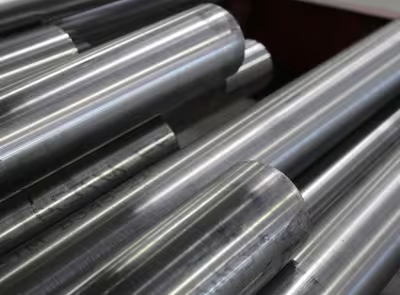
Ti-6AL-4V ELI, AMS 4930, is a general-purpose alpha-beta alloy that has superior damage tolerance and better mechanical properties at cryogenic temperatures compared to standard Ti-6AL-4V. The ELI (extra low interstitials) variant possesses high cycle fatigue strength and is available for fracture critical applications, such as medical implants or aerospace applications. This alloy, often referred to as Titanium Grade 23, is biocompatible, features moderately high tensile strength, improved ductility, good fatigue strength, intermediate fracture toughness, and high resistance to general corrosion in seawater. One advantage of Ti-6AL-4V ELI over other materials used in implant devices is its low elastic modulus, which is more similar to that of bone than other biocompatible materials. It is hardenable in sections up to 1" thick.
- Inventory & Specs
- Chemical Composition
- Physical Properties
- Mechanical Properties
- Datasheet
- Additional Info
- FAQs
Inventory Size Ranges for Ti-6AL-4V ELI
| Type | Size Range | AMS Standards | ASTM | UNS | Get a Quote |
|---|---|---|---|---|---|
| Plate | 0.250" - 1.000" | AMS 4907 | ASTM B 265 Grade 23, ASTM F 136 | UNS R56401, UNS R56407 | Get a Quote |
| Bar | 0.125" - 3.000" | AMS 4930, AMS 6932 | ASTM B 348 Grade 23, ASTM F 136 | UNS R56401, UNS R56407 | Get a Quote |
Advanced Inventory Size Ranges for Ti-6AL-4V ELI
| Type | Size Range | Get a Quote |
|---|---|---|
| Powder | Get a Quote |
Characteristics of Ti-6AL-4V ELI
Ti-6AL-4V ELI spontaneously and immediately forms a stable, continuous, tightly adherent oxide film upon exposure to oxygen in air or water. This accounts for its excellent corrosion resistance in a variety of environments. This alloy, like other titanium alloys, is susceptible to hydrogen embrittlement. It is important to minimize hydrogen pickup during processing, particularly during heat treatment and acid pickling. The ELI grade should be specified whenever toughness is a priority, as its toughness is superior to that of the standard Ti-6AL-4V grade.
Working with Ti-6AL-4V ELI
Ti-6AL-4V ELI wrought products are typically used in either a mill annealed, beta annealed, or recrystallization annealed condition. The mill anneal retains the wrought alpha + beta structure and has been used to maximize strength for applications such as total joint replacements. The beta anneal results in a completely transformed structure and is used to maximize damage tolerance at the expense of ductility. The recrystallization anneal produces a partially transformed structure designed to optimize damage tolerance while still maintaining ductility. Stress Relief heat treatments are also used on Ti-6AL-4V ELI.
Grade 23 titanium can be hot worked by standard methods, including hot rolling, forging, and hot pressing. Typically, this work is done at approximately 1600-1740°F (870-950°C). The yield strength of this alloy drops off rapidly with temperature, making it readily formable at intermediate temperatures. Warm forming has been used extensively in the manufacturing of aircraft components and medical devices. Ti-6AL-4V ELI can be cold drawn and extruded, although cold workability is limited.
Ti-6AL-4V ELI can be welded using filler metal. Inert gas shielding techniques must be employed to prevent oxygen pickup and embrittlement in the weld area. Gas tungsten arc welding is the most common welding process for this alloy and is used for thick sections. Plasma arc welding, spot welding, electron beam, laser beam, resistance welding, and diffusion welding have all also been used successfully.
Other industry standards we comply with:
- ASM/MIL-81200
- GE Aircraft Engine (GT193)
Common Trade Names
- Grade 23 Titanium
- Ti 6-4 ELI
- 6AL4V ELI
Industry Applications for Ti-6AL-4V ELI
- Medical Implants and Instrumentation
- Maxillofacial, dental, spinal, trauma, orthopedic and extremities
- Air frames
- Jet and engine rocket components
- Pressure vessels
- Fasteners
- Prosthetic Implants
- Geothermal-well casings
- Automotive components
- Sports equipment
Chemical Composition
| Element | Min | Max | |
|---|---|---|---|
| Ti | Titanium | 88.0 | 91.0 |
| Al | Aluminum | 5.5 | 6.5 |
| V | Vanadium | 3.5 | 4.5 |
| N | Nitrogen | 0.03 | |
| C | Carbon | 0.08 | |
| O | Oxygen | 0.013 | |
| Fe | Iron | 0.25 | |
| H | Hydrogen | 0.0125 | |
| - | Res. Each | 0.1 | |
| - | Res. Total | 0.4 | |
Physical Properties
| Physical Property | T (°F) | T (°C) | Value | Value (SI) |
|---|---|---|---|---|
Density | 72 | 22 | 0.163 lb in¯³ | 4.42 g cm¯³ |
Beta Transus | 1825±25 | 966±14 | - | - |
Melting (liquidus) Point | 3000-3020±25 | 1650-1660±14 | - | - |
| Thermal Conductivity | 68 | 20 | 3.8 Btu hr¯¹°F¯¹ | 6.6 W m¯¹ K¯¹ |
| Mil Annealed | 600 | 315 | 6.1 Btu hr¯¹°F¯¹ | 10.6 W m¯¹ K¯¹ |
| Specific Heat | 68 | 20 | 0.140 Btu lb¯¹°F¯¹ | 0.580 J g¯¹K¯¹ |
| 800 | 425 | 0.160 Btu lb¯¹°F¯¹ | 0.670 J g¯¹K¯¹ | |
| 1600 | 870 | 0.220 Btu lb¯¹°F¯¹ | 0.930 J g¯¹K¯¹ | |
| Electrical Resistivity | 32 | 0 | 66 μΩ∙in | 1.68 μΩ∙m |
| 600 | 315 | 73 μΩ∙in | 1.86 μΩ∙m | |
| 1200 | 650 | 74μΩ∙in | 1.89 μΩ∙m | |
| Magnetic Permeability | 1.00005 at 20 oersteds | |||
| Mean Coefficient of Thermal Expansion | 32-212 | 0-100 | 5.0 x 10¯⁶in in ¯¹°F¯¹ | 9.0x10¯⁶⁶m m¯¹°C¯¹ |
| 70-800 | 20-425 | 5.2 x 10¯⁶in in ¯¹°F¯¹ | 9.4x10¯⁶m m¯¹°C¯¹ | |
| 70-1200 | 20-650 | 5.4 x 10¯⁶in in ¯¹°F¯¹ | 9.7x10¯⁶m m¯¹°C¯¹ | |
| Young's Modulus | 68 | 20 | 15.5-17.7 Msi | 107-122 GPa |
| 450 | 230 | 13.8-16.2 Msi | 95-111 GPa | |
| Shear Modulus | 68 | 20 | 5.9-6.5 Msi | 41-45 GPa |
| Poisson's Ratio | 68 | 20 | .31 | .31 |
Mechanical Properties
| Product | Condition | Specification | Dir. | Temp, °F (°C) | UTS, ksi (MPa) | .02% YS, ksi (MPa) | %EI | %RA |
|---|---|---|---|---|---|---|---|---|
0.025-1.000 Sheet & Plate | St | ASTM B265 | L & LT | 68 (20) | 120 (828) | 110 (759) | 10 | - |
≤3.00 RD or Thk. | Annealed | ASTM B348 | L | 68 (20) | 120 (828) | 110 (759) | 10 | 25 |
≥1.75 RD or Thk. 1.75-2.50 2.50-4.00 | Annealed Annealed Annealed | ASTM F136 ASTM F136 ASTM F136 | L L & LT L, LT & ST | 68 (20) 68 (20) 68 (20) | 120 (828) 120 (860) 120 (825) | 115 (759) 110 (760) 115 (760) | 10 8 8 | 25 20 15 |
Datasheet
Additional Info
A Brief History of Ti-6AL-4V ELI
Ti‑6Al‑4V ELI (Extra Low Interstitial) emerged as a specialized variant of the widely used Ti‑6Al‑4V alloy during the rapid expansion of aerospace and medical technology in the mid‑20th century. Engineers recognized that while standard Ti‑6Al‑4V offered excellent strength‑to‑weight performance, certain critical applications—especially implants and cryogenic systems—required greater ductility, improved fracture toughness, and higher purity. This led to the refinement of the alloy’s chemistry, reducing interstitial elements like oxygen, nitrogen, and carbon to create a cleaner, more reliable material. Ti‑6Al‑4V ELI quickly became the preferred titanium grade for applications where failure was not an option.
How Ti-6AL-4V ELI Was Developed
Ti‑6Al‑4V ELI was developed by modifying the chemistry of standard Ti‑6Al‑4V to achieve lower interstitial content, especially oxygen. These interstitials, while strengthening the alloy, also reduce ductility and toughness—undesirable traits in medical implants or components exposed to extreme temperatures.
By tightening the purity controls and lowering interstitials, metallurgists created an alloy with:
- Higher fracture toughness
- Better fatigue resistance
- Improved ductility
- Superior biocompatibility
- Enhanced performance at cryogenic temperatures
This made Ti‑6Al‑4V ELI a breakthrough material for both medical and aerospace engineering.
Early Applications of Ti-6AL-4V ELI
Once introduced, Ti‑6Al‑4V ELI quickly found its way into industries where purity, toughness, and reliability were paramount.
Early use cases included:
- Orthopedic implants (hip stems, bone screws, plates)
- Dental implants
- Aerospace fasteners and structural components
- Cryogenic vessels and hardware
- High‑performance springs and precision components
Its combination of strength, purity, and biocompatibility made it one of the first titanium alloys widely adopted for long‑term implantation in the human body.
How Ti-6AL-4V ELI is Used Today
Today, Ti‑6Al‑4V ELI remains one of the most important titanium alloys in the world, especially in medical, aerospace, defense, and high‑performance engineering.
- Orthopedic implants (joint replacements, trauma hardware, spinal cages)
- Dental implants and abutments
- Surgical instruments
- Aerospace structural components
- High‑strength fasteners
- Cryogenic systems
- High‑performance sporting goods
- Additive manufacturing feedstock (powder and wire)
Its exceptional biocompatibility and mechanical reliability make it the gold standard for implantable titanium materials.
Your Trusted Supplier of Ti-6AL-4V ELI
United Performance Metal stocks Ti-6AL-4V in plate sizes 0.250" - 1.000" and bar sizes 0.125" - 3.000". UPM's plate products offer tight tolerance on cut piece orders and cut-to-length blanks that are individually marked with up to four lines of information. Ti-6AL-4V ELI bar provides consistent machinability and minimal distortion. UPM offers parallel surfaces and ready-to-fit milling fixtures.
Product FAQs
Ti-6AL-4V ELI offers corrosion resistance, biocompatibility, and a high strength to weight ratio. This alloy is best for applications where there is low oxygen to improve the material's ductility, toughness, and biocompatibility. Popular applications for Ti-6AL-4V ELI include medical implants, airframe and engine rocket components, pressure vessels, and fasteners.
Ti-6AL-4V ELI has lower interstitial content, higher toughness, better fatigue resistance, superior performance at cryogenic temperatures, and enhanced biocompatibility. These improvements make it the preferred grade for medical implants and critical aerospace components.