
Alloy C263 Sheet & Plate - Nimonic 263 - AMS 5872
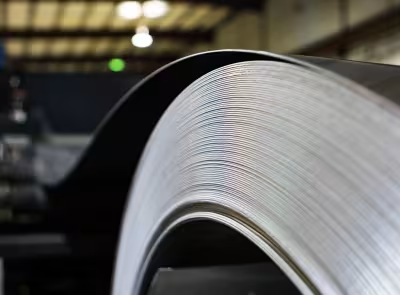
Alloy C263 (Nimonic® 263) is an age‑hardenable nickel‑cobalt‑chromium‑molybdenum superalloy engineered to deliver an excellent balance of high‑temperature strength, oxidation resistance, and fabrication capability. Designed to provide superior ductility and weldability in the annealed condition, Alloy C263 offers significantly easier forming and joining characteristics than higher‑strength gamma‑prime alloys such as Waspaloy® or René 41. While its elevated‑temperature strength is slightly lower than those alloys, Alloy C263 provides outstanding performance up to 1650°F (900°C) and is ideally suited for fabricated components in aircraft turbine engines and land‑based gas turbines, including combustor assemblies, transition liners, rings, and hot‑section hardware.
- Inventory & Specs
- Chemical Composition
- Physical Properties
- Mechanical Properties
- Datasheet
- Additional Info
- FAQs
Inventory Size Ranges for C263
| Type | Size Range | AMS Standards | UNS | Get a Quote |
|---|---|---|---|---|
| Coil | 0.040" - 0.125" | AMS 5872 | UNS N07263 | Get a Quote |
| Sheet | 0.040" - 0.125" | AMS 5872 | UNS N07263 | Get a Quote |
| Plate | 0.1875" | AMS 5872 | UNS N07263 | Get a Quote |
Characteristics of C263
Alloy C263 is non‑magnetic, possesses high strength up to 1500°F (816°C), and provides good oxidation resistance up to 1800°F (982°C). It exhibits excellent intermediate‑temperature tensile ductility and is noted for its ability to avoid the strain‑age cracking issues that affect many other gamma‑prime strengthened superalloys. The alloy’s combination of strength, oxidation resistance, and ductility makes it a dependable choice for components exposed to thermal cycling, combustion gases, and stress at elevated temperatures.
Working with C263
Alloy C263 offers excellent welding characteristics, supporting most common welding processes including TIG, GMAW, electron‑beam, and resistance welding, though oxyacetylene and submerged‑arc welding are not recommended. Excessive heat input should be avoided, and when filler metal is required, a matching C263 filler should be used for best results. After forming or welding, components are typically given a full solution anneal followed by aging to develop optimum mechanical properties. Alloy C263 also maintains excellent ductility in the annealed state, making it suitable for cold‑working operations, while machining requires rigid setups and sharp tooling to prevent work hardening and glazing.
Other industry standards we comply with:
- B50A774
- W.Nr. 2.4650
- Predominantly produced by AOD-ESR melt method. Hot worked, solution treated (annealed), then descaled
Common Trade Names
- Nimonic C263®
Industry Applications for C263
- Low Temperature Combustors
- Transition Liners
- Ring Components
Chemical Composition
| Element | Min | Max | |
|---|---|---|---|
| Ni | Nickel | - | 52.00 |
| Co | Cobalt | - | 20.00 |
| Cr | Chromium | - | 20.00 |
| Mo | Molybdenum | 6.0 | 2.4 |
| Ti | Titanium | - | 0.6 |
Physical Properties
| Property | Value |
|---|---|
| Density | 0.302 lbs/in3 |
Non-magnetic
Alloy C263 plate - Nimonic 263 plate has high strength up to 1500ºF (816°C) and good oxidation resistance up to 1800ºF (982°C).
Annealed Condition
Alloy C263 nickel plate has excellent ductility and may be formed by cold working.
Mechanical Properties
Plate has excellent welding characteristics and can be welded by most customary techniques, such as inert gas tungsten arc (TIG), gas metal arc welding (GMAW), electron beam and resistance welding. Oxyacetylene and submerged arc processes are not recommended. Avoid excessive heat input when welding and when a filler metal is required a matching C-263 filler metal should be used. This grade is typically used in the fully aged condition. Following forming and welding, a full solution anneal prior to aging is often employed to develop optimum properties.
Hardness
Typically 200 BHN. Grain structure is austenitic at both cryogenic and elevated temperatures.
Typical Stock Removal Rate
20 surface feet/minute with high speed tools. 80 surface feet/minute with carbide.
Care
Care must be taken to ensure a rigid machine setup and sharp tools, so that work hardening and surface glazing do not occur.
Datasheet
Additional Info
A Brief History of Alloy C263
Alloy C263—also known as Nimonic® 263, UNS N07263, W.Nr. 2.4650—was developed in the early 1970s as turbine technology pushed the need for a material that combined high‑temperature strength, oxidation resistance, and excellent fabrication characteristics. Originally produced by Rolls‑Royce in 1971, Alloy C263 was created to replace less formable superalloys such as Nimonic 80A, offering better weldability and ductility while still providing strong elevated‑temperature mechanical performance. It is an age‑hardenable nickel‑cobalt‑chromium‑molybdenum alloy designed for service in the 1200–1650°F (650–900°C) temperature range, where creep resistance, thermal stability, and oxidation resistance are essential.
How Alloy C263 Was Developed
Metallurgists sought an alloy that could achieve gamma‑prime strengthening while avoiding the strain‑age cracking seen in other high‑temperature superalloys. Alloy C263 achieves this balance through a controlled composition of nickel, cobalt, chromium, molybdenum, and titanium, combined with a precipitation‑hardening heat treatment. This composition enables:
- High strength in the fully aged condition
- Excellent formability and ductility in the solution‑annealed condition
- Good weldability without preheat requirements
- Stability in hot‑gas environments
Unlike alloys such as Waspaloy® or Rene 41, C263 was engineered to be far easier to form, fabricate, and weld, making it ideal for complex turbine components requiring both shapeability and high temperature capability.
Early Applications of Alloy C263
As jet engine and industrial turbine designs evolved, Alloy C263 quickly found widespread use in components requiring a balance of formability during manufacturing and strength during service. Early applications included:
- Combustion liners and transition ducts
- Ring components for gas turbines
- Low‑temperature combustor assemblies
- Hot‑section fabricated parts in early aerospace engines
Its excellent intermediate‑temperature tensile ductility allowed C263 to outperform competing superalloys that suffered from cracking or poor cold‑forming behavior.
How Alloy C263 Is Used Today
Today, Alloy C263 continues to be a premier material for combustion-section components in both aircraft and land-based gas turbines. Its versatility and mechanical reliability make it ideal for aerospace, industrial gas turbines, and high temperature fabricated parts. Alloy C263 is valued for its non‑magnetic nature, oxidation resistance up to 1800°F, and high strength up to 1500°F. It remains one of the most formable and weldable gamma‑prime strengthened superalloys in turbine service.
Your Trusted Supplier for Alloy C263
United Performance Metals offers Alloy C263 in coil, sheet, and plate, supplied to common aerospace specifications such as AMS 5872. With excellent formability in the annealed condition, exceptional weldability, and strong elevated‑temperature performance, Alloy C263 is ideal for customers manufacturing combustion‑section hardware, turbine liners, rings, and other high‑temperature fabricated components.
Contact our team today to learn how Alloy C263 can improve the performance and reliability of your next turbine or high‑temperature application.