
347 Stainless Steel Sheet, Coil and Bar - AMS 5512, 5646
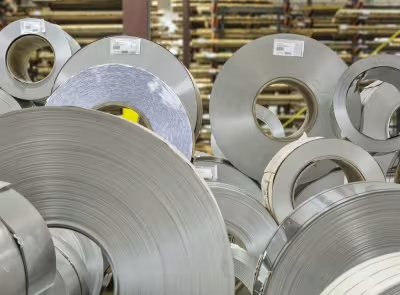
347 stainless steel is a columbium/tantalum stabilized austenitic chromium-nickel stainless steel. Type 347 has excellent intergranular corrosion resistance and oxidation resistance. at high temperatures. This material is stabilized against chromium carbide formation by the addition of columbium and tantalum. Since these elements have a stronger affinity for carbon than chromium, columbium-tantalum carbides precipitate within the grains instead of forming at the grain boundaries. 347 should be considered for applications requiring intermittent heating between 800ºF (427ºC) and 1650ºF (899ºC) or for welding under conditions which prevent a post-weld anneal. 347 is non-magnetic.
- Inventory & Specs
- Chemical Composition
- Physical Properties
- Mechanical Properties
- Datasheet
- Additional Info
- FAQs
Inventory Size Ranges for 347
| Type | Size Range | AMS Standards | ASTM | UNS | ASME | Get a Quote |
|---|---|---|---|---|---|---|
| Coil | 0.020" - 0.125" | AMS 5512, AMS 5646 | ASTM A 269, ASTM A 276, ASTM A193 | UNS S34700 | ASME SA 269, ASME SA 276 | Get a Quote |
| Sheet | 0.020" - 0.125" | AMS 5512, AMS 5646 | ASTM A 269, ASTM A 276, ASTM A193 | UNS S34700 | ASME SA 269, ASME SA 276 | Get a Quote |
| Bar | 0.375" - 4.000" | AMS 5512, AMS 5646 | ASTM A 269, ASTM A 276, ASTM A193 | UNS S34700 | ASME SA 269, ASME SA 276 | Get a Quote |
| Precision Reroll Strip | 0.0008" - 0.015" | Get a Quote |
Characteristics of 347
347 is advantageous for high temperature service, offering high resistance to intergranular corrosion and oxidation at high temperatures. 347 offers similar resistance to general, overall corrosion as the unstabilized chromium nickel Type 304. Heating for long periods of time in the chromium carbide precipitation range may affect the general resistance of Types 347 in severe corrosive media. 347 stainless is preferable for aqueous and other low temperature environments. Exposure in the 800 to 1500°F (427 to 816°C) temperature range lowers the overall corrosion resistance of 321 alloy to a much greater extent than 347 alloy. When the unstabilized chromium-nickel steels are held in or slowly cooled through the range of 800 to 1500°F (427 to 816°C), chromium carbide is precipitated at the grain boundaries. In the presence of certain strongly corrosive media, these grain boundaries are preferentially attacked, a general weakening of the metal results, and a complete disintegration may occur.
Working with 347
When machining 347, it is slightly tougher than 304 and work-hardens quickly. It is important to use sharp tools and keep consistent, firm feed rates. 347 is extremely weldable due to its niobium and carbon composition which prevents carbine precipitation. Additionally, the heat-affected zones stay corrosion resistant and there is no need for post-weld annealing in a majority of cases. 347 is excellent for heavy-section welds and high temperature service. Stainless steel 347 is able to handle continuous service up to ~1600°F (870°C) and intermittent service even higher. This alloy also has better creep strength compared to 304 and 321, making it suitable for pressure vessel, exhaust manifold, and high temperature piping applications. Similar to 304, 347 offers good ductility and deep-drawn performance when formed. If extreme formability is needed, grades 305 and 304 are easier choices for fabrication.
Other industry standards we comply with:
- EN 1.4550
- PWA-LCS
- GE Aircraft Engine (GT193)
- RR SABRe Edition 2
- DFARS Compliant
Common Trade Names
- ATI 347 (™ Allegheny Technologies)
Industry Applications for 347
- Aircraft collector rings
- Aircraft exhaust stacks
- Boiler casings
- Cabin heaters
- Furnace heating elements
- Heavy wall welded equipment
Chemical Composition
| Element | Min | Max | |
|---|---|---|---|
| C | Carbon | - | 0.080 |
| Mn | Manganese | - | 2.00 |
| P | Phosphorus | - | 0.045 |
| S | Sulfur | - | 0.03 |
| Si | Silicon | - | 0.75 |
| Cr | Chromium | 17.00 | 19.00 |
| Ni | Nickel | 9.00 | 12.00 |
| Nb/Ta | Columbium & Tantalum | 10xC | 1.00 |
| Fe | Iron | - | Balance |
Physical Properties
- Magnetic Permeability: H/m Anneal 1.02 Max
| Grade | Density | Modulus of Elasticity in Tension | Melting Range | |||
|---|---|---|---|---|---|---|
| g/cm3 | lb/in3 | psi | GPa | °C | °F | |
| 321 | 7.92 | 0.286 | 28 x 106 | 193 | 1398-1446 | 2550-2635 |
| 347 | 7.96 | 0.288 | 28 x 106 | 193 | 1398-1446 | 2550-2635 |
| Temperature Range | Coefficients | ||
|---|---|---|---|
| °C | °F | cm/cm/°C | in/in/°F |
| 20-100 | 68-212 | 16.6 x 10⁻⁶ | 9.2 x 10⁻⁶ |
| 20-600 | 68-912 | 18.9 x 10⁻⁶ | 10.5 x 10⁻⁶ |
| 20-1000 | 68-1832 | 20.5 x 10⁻⁶ | 11.4 x 10⁻⁶ |
| Temperature Range | W/m·K | Btu · in / hr · ft2 · °F | |
|---|---|---|---|
| °C | °F | ||
| 20-100 | 68-212 | 16.3 | 112.5 |
| 20-500 | 68-932 | 21.4 | 147.7 |
| Temperature Range | J/kg K | Btu/lb · °F | |
|---|---|---|---|
| °C | °F | ||
| 0-100 | 32-212 | 500 | 0.12 |
| Temperature Range | microhm·cm | |
|---|---|---|
| °C | °F | |
| 20 | 68 | 72 |
| 100 | 213 | 78 |
| 200 | 392 | 86 |
| 400 | 752 | 100 |
| 600 | 1112 | 111 |
| 800 | 1472 | 121 |
| 900 | 1652 | 126 |
Mechanical Properties
| Property | Type 321 | Type 347 |
|---|---|---|
| Yield Strength 0.2% Offset, psi (MPa) | 30,000 (205) | 30.000 (205) |
| Ultimate Tensile Strength, psi (MPa) | 75,000 (515) | 75,000 (515) |
| % Elongation in 2 in. or 51 mm | 40.0 | 40.0 |
| Hardness Max., Brinell (Plate) | 217 | 201 |
| Hardness Max., RB (Sheet & Strip) | 95 | 92 |
Datasheet
Additional Info
A Brief History of 347
347 stainless steel emerged as part of the evolution of 18‑8 austenitic stainless steels, which began in the early 20th century. Engineers recognized that standard 304 suffered from intergranular corrosion when exposed to 800–1500 °F — especially during welding. To solve this, metallurgists introduced niobium (also called columbium) as a stabilizing element. This stabilization prevented chromium carbide formation and preserved corrosion resistance at elevated temperatures. Over time, 347 became a preferred alloy for high‑temperature, welded, and cyclic‑thermal environments.
How 347 Was Developed
Standard 304 stainless steel loses corrosion resistance when chromium carbides form at grain boundaries during heating. Metallurgists added niobium/tantalum to bind with carbon, forming stable niobium carbides instead of chromium carbides. This innovation prevented intergranular corrosion, improved high-temperature strength, enhanced creep resistance, and made the alloy more reliable for welded structures. The result was Type 347 (UNS S34700) — a stabilized, heat‑resistant stainless steel.
Early Applications of 347
Early uses focused on industries requiring heat resistance and weld stability. Applications included chemical processing equipment, refinery and petrochemical piping, boilers, superheaters, heat exchangers, aircraft exhausts, engine components, furnace parts, thermal processing equipment, and expansion joints and bellows. These applications leveraged 347’s ability to resist carbide precipitation and maintain strength under thermal cycling.
How 347 is Used Today
347 remains a major alloy for high‑temperature, corrosive, and welded environments, especially where long‑term stability is required.
- Aerospace: Jet engine parts, exhaust manifolds, thermal shields
- Petrochemical & Refining: Furnace tubes, reformer components, high-temperature piping
- Power Generation: Boiler casings, superheater tubes, turbine components
- Industrial Manufacturing: Expansion joints, bellows, welded assemblies
- Chemical Processing: Heat exchangers, reactors, high-temperature vessels
Your Trusted Supplier for 347 Stainless
United Performance Metals stocks 347 coil and sheet sizes 0.020" - 0/125", bar sizes 0.375" - 4.000", and precision rerolled strip 0.0008" - 0.015". Some of the most common applications for this material include aircraft collector rings and exhaust stacks, boiler casings, cabin heaters, furnace heating elements, and heavy wall welding equipment.
Product FAQs
347 stainless steel offers excellent weldability, superior high-temperature performance, resistance to intergranular corrosion, and demonstrates better creep strength than grades 304 and 321.
347 has niobium stabilization, which prevents intergranular corrosion. 304 does not, so it can be sensitive in the heat-affected zone. 347 is preferred for high-temperature or welded applications.
321 uses titanium for stabilization while 347 uses niobium, which offers better creep resistance at high temperatures.